
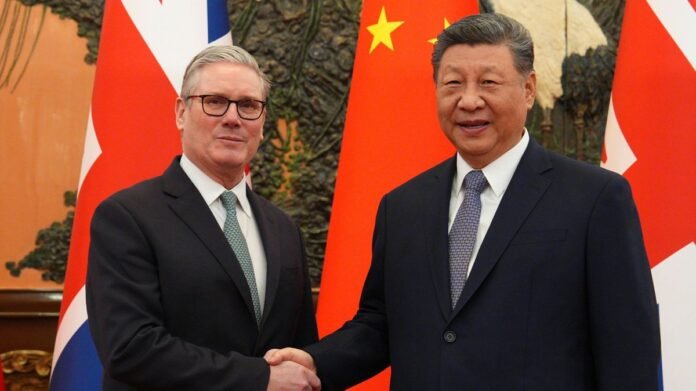


During the recent exchange in Beijing between China’s President Xi and Keir Starmer, the conversation reportedly took an interesting turn. It was said that President Xi praised Starmer for his strong leadership style in handling opposition, while Starmer mentioned a past political maneuver that saved him from potential defeat.
While the above scenario may be fictional, it highlights the significance of a key electoral battle in Gorton and Denton, Manchester. This formerly overlooked area has now become a focal point due to the upcoming election. The outcome in this constituency could potentially determine Starmer’s political future.
Starmer’s decision to prevent Andy Burnham from contesting the election has drawn criticism, with many viewing it as a move to safeguard his own position rather than a genuine concern for the party. This perceived self-preservation tactic has raised doubts about Starmer’s leadership capabilities, especially in light of recent policy reversals by his government.
The dwindling support for Labour under Starmer’s leadership is evident from the loss of members and declining popularity in polls. The need for authentic representation in politics is emphasized, with Burnham seen as a more relatable figure compared to Starmer’s detached approach.
The upcoming election in Gorton is crucial for Labour to counter the rise of divisive politics represented by Reform’s candidate, Matthew Goodwin. Goodwin’s controversial views on British identity could resonate with disillusioned voters, posing a challenge for Labour to retain the seat.
It is imperative for Labour to reconnect with working-class voters and present a compelling alternative to the polarizing rhetoric espoused by Farage and the Greens. Burnham’s background and experience make him a suitable candidate to bridge this gap, whereas a continuation of Starmer’s leadership may struggle to resonate with the electorate.
The possibility of Farage gaining ground in the next election due to voter disillusionment with mainstream parties underscores the need for a strategic shift in Labour’s approach. Embracing a more grassroots, people-centric strategy could help Labour regain lost ground and counter the appeal of populist leaders.
The evolving political landscape presents challenges and opportunities for parties to redefine their narratives and engage with voters effectively. As the political dynamics continue to shift, the outcomes of local elections like the one in Gorton will have broader implications for the future of British politics.