
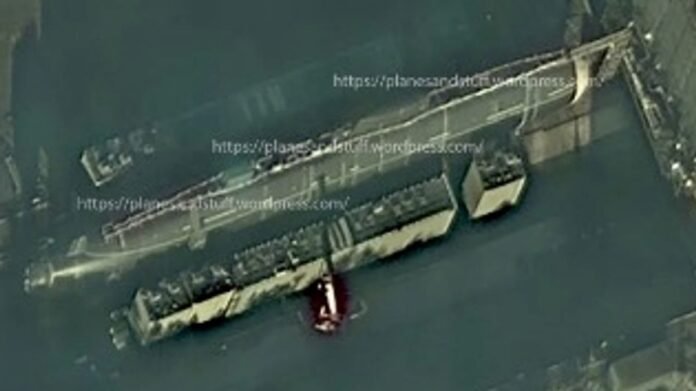


Newly released satellite images showcase the impressive size of Russia’s latest nuclear-powered submarine, equipped to launch powerful nuclear torpedoes. The Khabarovsk-class submarine, a recent addition to Moscow’s nuclear arsenal, was revealed in its entirety through the latest satellite footage while stationed at the Sevmash shipyard.
Construction of the Khabarovsk-class submarines, part of Project 09851 for the Russian Navy, is underway at the Sevmash shipyard. This nuclear submarine, measuring approximately 135-140 meters in length and 13.5 meters in width, is specifically designed to deploy Russia’s advanced nuclear-powered ‘Poseidon’ torpedoes.
The Poseidon torpedoes possess the capability to generate destructive tsunamis, posing a significant threat to coastal cities. Beyond their nuclear warhead capacity, they boast an ‘intercontinental range’ for extended operational reach.
Described as a “nuclear-powered missile cruiser” by the Russian Ministry of Defence, the Khabarovsk submarine remains shrouded in secrecy, with primary armament likely to be the Poseidon torpedoes. Although its launch in Severodvinsk was delayed by five years, Defense Minister Andrei Belousov emphasized the submarine’s role in safeguarding Russia’s maritime borders and national interests worldwide.
Powered by a nuclear engine, the Khabarovsk submarine can submerge to depths of around 500 meters and operate at sea for extended periods. With a reported construction cost exceeding £1 billion, the vessel’s design elements remain experimental, reflecting Moscow’s cautious approach to Western scrutiny.
Another submarine of the same class, the Ulyanovsk, is currently under construction to bolster Russia’s Pacific Fleet. Together, these submarines will enhance Russia’s maritime capabilities, particularly in deploying the Poseidon system to project power globally.
The upcoming sea trials will precede the Khabarovsk submarine’s integration into Russia’s nuclear deterrent fleet, featuring the Poseidon system, also known as Kanyon. This innovative system, with unique specifications breaking traditional nuclear deterrence norms, has drawn attention from arms control experts and global observers.
Russian President Vladimir Putin recently announced successful underwater tests of the Poseidon system, highlighting its potency compared to existing intercontinental-range missiles. Putin underscored the system’s unparalleled speed and depth capabilities, positioning it as a strategic response to perceived threats posed by the US missile defense shield.
By continuing to use our website, you consent to the use of cookies and acknowledge our Privacy Notice and Terms and Conditions.