
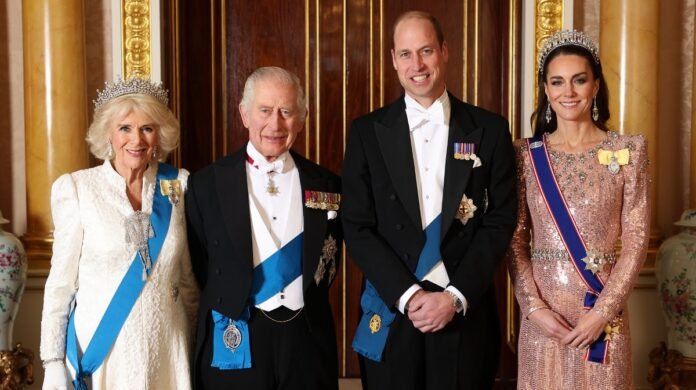


What was the level of awareness Charles, William, and the previously esteemed Elizabeth II had regarding Andrew Mountbatten-Windsor’s alleged controversial activities related to sex, financial dealings, trading reports, and questionable associates?
Despite widespread negative opinions about the eighth successor to the throne, the royal family continued to provide accommodation and financial support to their son, brother, and uncle. The reigning monarch and former queen even provided a £12 million loan to prevent his involvement in a legal case in the United States.
This willful ignorance and indifference enabled his behavior, making it ineffective to assert that he was not truly part of the family, revoke his titles, and state that law enforcement should take appropriate action. Such actions will not be accepted by anyone except those easily deceived.
This situation has irreversibly altered the monarchy.
Andrew and those who enabled him have caused significant damage to the outdated institution from within. This crisis surpasses the impact of Edward VIII’s abdication in 1936, which led to the succession of George VI, with minimal disruption. However, the current situation is unique and offers a chance for transformation.
Republic, a democracy advocacy group, estimates that the royal family costs the public over £510 million annually in various expenses such as grants, subsidies, tax exemptions, security, helicopters, and jets. The increased public scrutiny, particularly due to revelations about Andrew’s connection to Jeffrey Epstein, is unveiling truths that can never be concealed again.
The exorbitant cost of supporting self-serving royals is unjustifiable, particularly as fewer people wish to be represented by this institution. This may lead to a marginalized monarchy similar to the Dutch model or the British public opting to elect their head of state rather than inherit a privileged family.
Recent events have made such outcomes a real possibility in the foreseeable future. Tony Blair intervened to support the Queen after Princess Diana’s death, advising the aloof monarch to display a half-mast flag at Buckingham Palace to appease upset individuals protesting the perceived disrespect towards the deceased Princess.
Keir Starmer reportedly advised Charles to distance himself from his now-arrested brother, but the King was compelled belatedly to take appropriate action. Even Prince William is facing scrutiny, and changing leadership alone will not resolve the family’s collective evasion of accountability for systemic failures within a tainted institution.
The public and Parliament are demanding change. There is no going back to the past; the focus is now on determining the future direction.
Predicting the outcome of the crucial Gorton and Denton by-election this week is challenging given the circumstances. However, it is likely that the combined support for Labour and the Green Party will surpass that for Reform, prompting voters to strategically consider the best option to prevent an undesirable outcome.
It is imperative that tactical voting aligns with the interests of the majority. Allowing a split among the center and left-leaning voters could pave the way for far-right influence in national politics.
A defeat for Labour in a constituency they won with a significant majority two years ago would be a blow to Keir Starmer’s leadership, while a victory would mark a significant setback for Nigel Farage’s political ambitions. By-elections hold substantial importance and should not be underestimated.
The endorsement by five former Education Secretaries of Bridget Phillipson’s proposals to enhance education for 1.5 million children with special needs in England demonstrates effective government planning.
The support from prominent figures like David Blunkett, Estelle Morris, Charles Clarke, Ruth Kelly, and Alan Johnson emphasizes that the initiative is not solely driven by financial considerations. The notable increase in cases requiring additional support for nearly one in five children over the past decade addresses previously neglected educational needs.
While most children with special needs are appropriately integrated into mainstream education, the real issue lies in private schools, supported by profit-driven investors, charging taxpayers an average of £63,000 per student without evident benefits.
Bridget Phillipson’s efforts to persuade Keir Starmer and Rachel Reeves to lift the two-child benefit cap, which pushed half a million children into poverty, reflect her genuine commitment to assisting disadvantaged individuals. Her advocacy for social welfare is commendable.
Nigel Farage’s ill-conceived stunt regarding the Chagos Islands once again highlights his alignment with divisive tactics akin to those of former US President Trump.
Trump