
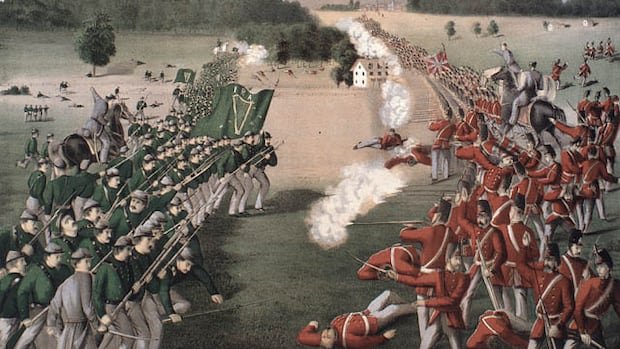


An unfamiliar clash that occurred on Canadian territory a year prior to Confederation may not resonate widely with Canadians beyond Fort Erie, Ont. However, the Battle of Ridgeway, also known as Limestone Ridge, in 1866 holds significance for various historical reasons. It marked the first instance of Canadian troops led by Canadian commanders engaging in battle. Furthermore, it served as the inspiration for Decoration Day, a precursor to Remembrance Day observed in certain regions annually.
Despite these historical milestones, the nine individuals who perished in the conflict are not included in the Books of Remembrance, an extensive collection on Parliament Hill cataloging the names of soldiers who died in service to the nation. A fresh petition slated for presentation in the House of Commons aims to have the nine fallen soldiers and the numerous others who lost their lives post-battle added to the list.
Conservative MP Fred Davies, who represents the Niagara South riding encompassing Fort Erie, where the battle unfolded, emphasized the importance of acknowledging those who gave their lives to defend Canada. The Battle of Ridgeway, involving inexperienced volunteers confronting Fenian raiders, predominantly American Civil War veterans, was a challenging ordeal for the ill-prepared Canadian troops in what was dubbed Canada’s first modern battle.
Although the Canadians faced a battlefield defeat, they managed to repel the Fenians, prompting a retreat back across the Niagara River. Despite the military setbacks, Davies underscored the valor and sacrifice of those who fought to protect Canada. A memorial honoring the nine soldiers who perished in the Battle of Ridgeway was erected in 2016, as Fort Erie persists in advocating for their inclusion in the Books of Remembrance.
Even though the battle predates the formal establishment of Canada, the significance of the event is recognized by many, with suggestions that it influenced the path to Confederation. The enduring impact of the Battle of Ridgeway is evident in the regiments that participated, such as the Queen’s Own Rifles and the Royal Hamilton Light Infantry, which still exist today. Alexander Muir, renowned for composing “The Maple Leaf Forever,” fought in the battle and may have drawn inspiration from the silver maple leaves of Toronto or the maple leaf insignia of the Queen’s Own Rifles.
The Battle of Ridgeway symbolized a shift towards Canadians fighting for their local communities rather than solely as British colonial subjects, emphasizing a newfound sense of national identity and unity.