
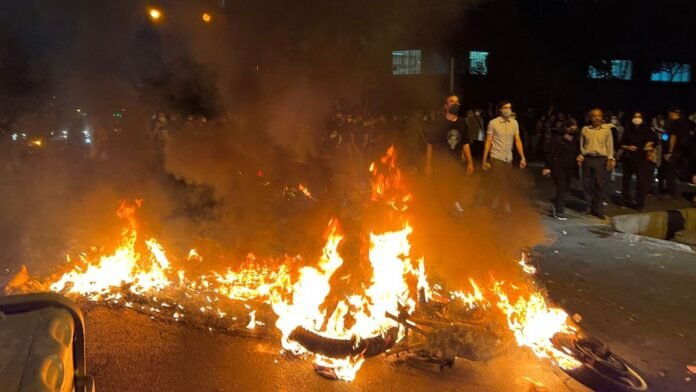


Britain and other Western nations are being urged by experts to distance themselves from Iran to allow for a potential democratic uprising to overthrow the Mullah regime that has been in power since 1979. Prominent Iranian dissidents believe that a growing rebel movement comprising around 20,000 covert cells could lead to the downfall of the Islamic Republic of Iran and its enforcement unit, the Revolutionary Guard Corps. This uprising, they claim, could materialize within months.
The rebel movement, with an estimated total of up to 100,000 or possibly more members, operates in secretive cells with around 10 rebels each. These cells work independently, maintaining secrecy and isolation from one another. Some reports suggest that the number of dissidents aligning with the MEK (the People’s Muhajideen Organization of Iran) has been increasing recently.
Despite the risks of public execution and clandestine burials, these rebels are becoming more vocal in their opposition to the current regime. There are indications that weapons have been smuggled into Iran to support the uprising if necessary. Dr. Majid Sadeghpour, an Iranian exile residing in the United States and a political director at the Washington-based Organization of Iranian American Communities, highlighted the regime’s heightened repression tactics amid looming political and military collapse.
The current Supreme Leader of Iran, Ayatollah Ali Khamenei, wields authoritative control over state policies, the military, and the judiciary. The Islamic Republic of Iran, established in 1979, erased the Family Protection Act of 1967 and imposed strict Islamic codes through enforcement committees. Dr. Sadeghpour, who lost his brother to the regime’s brutality, emphasized the organized and focused nature of the modern-day rebel groups, stressing their determination to challenge the oppressive regime.
The global community, led by the United States and including Britain, has been attempting to persuade Iran to alter its behavior despite its involvement in terrorism, nuclear weapons development, conflicts in various regions, and a record of human rights abuses. Dr. Sadeghpour dismissed the idea of negotiating with the regime, asserting that its violent and unyielding nature makes meaningful change unlikely.
While debates persist about the level of support for the rebel groups within Iranian society, Dr. Sadeghpour believes that grassroots backing is crucial for the survival of these covert units. In contrast, Professor Hamid Dabashi of Columbia University contends that the current ruling regime, despite facing opposition, still maintains significant support among the population, casting doubt on the widespread popularity of the rebel factions.
The possibility of an armed uprising is not ruled out, with Dr. Sadeghpour indicating that internal forces are already present within Iran. He emphasized the regime’s fascist and medieval nature, drawing parallels with historical oppressive regimes in Europe and the Ottoman Empire. Despite differing opinions on the potential success of the rebel movement, the call for change within Iran continues to gather momentum amidst escalating tensions and repressive measures by the ruling authorities.