
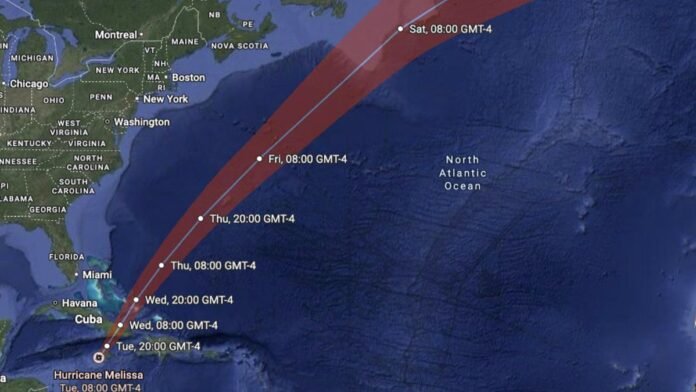


A powerful hurricane named Melissa, the most intense storm this year, is on the verge of hitting Jamaica, according to the National Hurricane Center. The Category 5 hurricane, with sustained winds of 175mph, is causing flash flooding and storm surges on the Caribbean island. It is currently a distance away but accelerating, expected to reach land around midday local time. Meteorologists predict Melissa could become the most forceful hurricane ever to strike Jamaica, bringing up to 30 inches of rain and 175mph winds.
The Met Office mentioned that Hurricane Melissa might impact the weather in the UK. A spokesperson stated that the storm is likely to lose its tropical characteristics in the North Atlantic and disperse later in the week. There is a slight chance that the remnants of Melissa could influence the UK weather next week. However, any significant disruptions are not expected at this time, though it might contribute to the unsettled weather already affecting the UK.
Following its impact on Jamaica, Melissa is projected to move towards eastern Cuba on Tuesday evening, where over 500,000 individuals have been evacuated from high-risk areas. By Wednesday, the storm is expected to reach the Bahamas, weakened to a Category 2 hurricane.
Melissa has already caused casualties in Jamaica, Haiti, and the Dominican Republic. The International Federation of Red Cross and Red Crescent Societies estimates that up to 1.5 million people in Jamaica could be affected by the storm, including around 25,000 tourists currently on the island. Forecasters anticipate Melissa to make landfall as a Category 5 hurricane and then weaken to a Category 4 as it crosses Jamaica.
Michael Brennan, director of the US National Hurricane Center, warned of the potentially catastrophic scenario, mentioning the likelihood of total building failures and extremely high wind gusts in Jamaica’s mountainous regions. Prime Minister Andrew Holness of Jamaica emphasized the lack of infrastructure capable of withstanding the storm’s impact.
Researchers suggest that the climate crisis is exacerbating hurricanes in the Caribbean, with Melissa intensifying rapidly due to warmer-than-average ocean temperatures influenced by climate change. The hurricane’s name, Melissa, follows the naming conventions of the US National Hurricane Center and the World Meteorological Organisation, rotating names on a six-year cycle and retiring only those associated with exceptionally devastating storms.
Maps tracking the storm’s path indicate that Melissa is expected to move into the North Atlantic and potentially affect Canada’s easternmost region.