
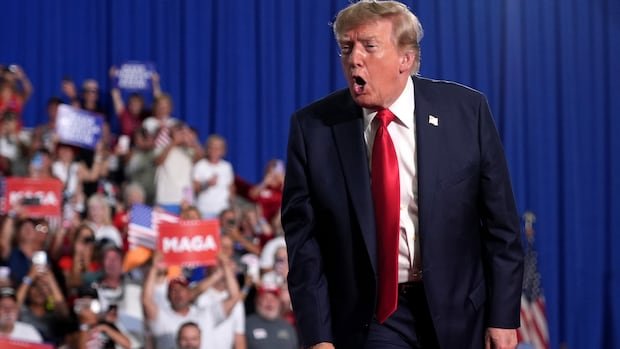


Members of Canada’s automotive industry are reacting with a blend of annoyance, uncertainty, and alarm to the recent declarations by U.S. President Donald Trump regarding a potential doubling of certain American tariffs on automobiles, trucks, auto components, and steel from Canada. Following Canada’s rejection of a U.S. trade proposition last Friday, Trump announced on Truth Social on Monday that the tariffs would increase to 50 percent from their current rates by January 1, 2027.
Lucas Malinowski, the CEO of Global Automakers of Canada, expressed difficulty in gauging the seriousness stakeholders in his sector should attach to Trump’s announcement. He noted that similar outbursts in the past did not necessarily result in alterations to tariff and trade policies, and they are now observing whether this time will be different. The industry group he leads represents major foreign automakers such as Toyota, Volkswagen, BMW, Honda, Hyundai, Nissan, and Mercedes-Benz.
Trump’s threat to escalate tariffs is the latest development in the Canada-U.S. trade conflict, which intensified after negotiations collapsed before the Friday midnight deadline to avert 50 percent U.S. tariffs on approximately $28 billion worth of Canadian goods. Prime Minister Mark Carney vowed on Saturday to match American tariffs “dollar for dollar” effective September 8, focusing on U.S. steel, dairy, appliances, agricultural equipment, pulp and paper, and electronics.
In a critical post on Monday morning, Trump criticized Canada, labeling it “among the worst Nations in the World to deal with.” He emphasized that the country heavily relies on the U.S., conducting 95% of its business with the nation. Currently, finished vehicles and non-CUSMA-compliant auto parts imported from Canada to the U.S. face 25 percent tariffs, while Canadian steel is subject to tariffs ranging from 10 percent to 50 percent.
Flavio Volpe, the president of the Automotive Parts Manufactures’ Association, clarified that the increased tariffs Trump is threatening would be borne by the U.S. auto industry, not Canadians. He explained that the “importer of record” is responsible for paying the tariffs, indicating that U.S. auto assembly would shoulder the burden. Volpe anticipated that members of the U.S. auto industry would be in communication with the White House regarding this issue.
Malinowski highlighted that the ongoing trade dispute has already impacted business operations negatively. He pointed out that Canada is the primary market for U.S.-manufactured vehicles, surpassing the next three export markets combined. U.S. exports to Canada have declined by 22 percent and $7 billion over the past year. Malinowski estimated that tariffs and trade disruptions have added $110 billion in expenses to North America’s automotive industry over the last 18 months.
Ontario Premier Doug Ford also weighed in on Trump’s tariff ultimatum, expressing strong disapproval. He characterized the U.S. president as arrogant and cocky, labeling him a bully and predicting that he will face consequences for his actions.