
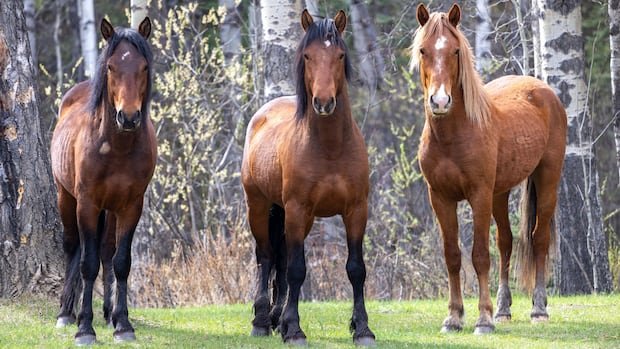


Health Canada has given the green light for a birth control vaccine to be trialed on free-roaming horses in Alberta. This move comes as the Alberta government addresses concerns over escalating horse populations, deemed as “unacceptable” in certain regions due to their impact on grazing lands for livestock and wildlife.
The province’s feral horse management framework includes contraception as a strategy for population control, alongside removal from the wild and adoption initiatives. In late August, the Alberta government secured a “research authorization” for the use of SpayVac-Equid, a contraception vaccine, as confirmed by a Health Canada spokesperson.
While the research authorization permits the study of the product on feral horses, it does not authorize its general use, according to the federal agency. Alberta officials are currently reviewing the specifics of the approval related to horse contraception, emphasizing a commitment to implementing management actions in a humane and science-based manner.
The most recent feral horse survey conducted by the province identified a record 2,072 wild horses across six equine management zones, with population levels in certain areas deemed unsustainable. The Alberta government categorizes these horses as stray animals rather than wildlife.
In a bid to tackle the population issue, a new contraceptive strategy is set to build upon past efforts. A prior contraception pilot project launched in 2014, using a different vaccine called ZonaStat-H, indicated challenges such as high costs and logistical issues in administering booster shots due to rugged terrains.
The upcoming strategy involves capturing horses, administering the SpayVac-Equid vaccine manually, and releasing the horses back into the wild, with marked individuals for identification purposes. This method is projected to have a success rate of 85 to 95 percent, offering contraception for three to four years without altering herd dynamics or necessitating booster shots.
The Wild Horses of Alberta Society plans to implement the contraception project this autumn, in conjunction with capturing a limited number of young stallions for removal from the wild. The society, known for rescuing and rehabilitating horses, has taken in over 200 horses since its inception in 2002.