
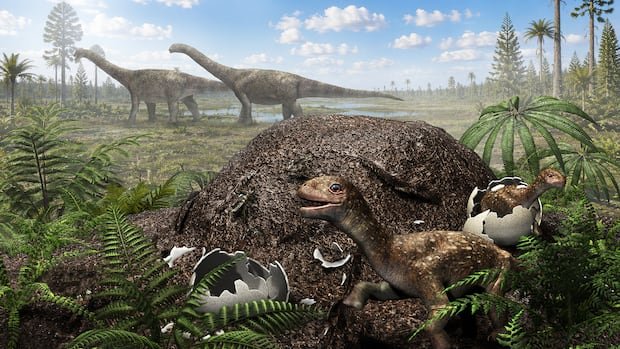


Fossilized eggshells believed to be from some of the largest dinosaurs ever discovered have been unearthed in a surprisingly cooler climate located far from the equator. Despite their immense size, these titanosaurs did not incubate their volleyball-sized eggs by sitting on them, as they were too large to do so effectively without risking damage to the eggs.
A recent study led by University of Tsukuba paleontologist Kohei Tanaka, in collaboration with researchers from Japan and Argentina, delved into the microscopic details of the eggshells to unveil the incubation method employed by titanosaurs. By examining the pore structure of the eggshells, the team concluded that titanosaurs likely utilized a technique similar to modern crocodiles, burying their eggs in warm piles of decomposing vegetation to maintain the necessary heat for successful hatching.
Titanosaurs, colossal herbivorous dinosaurs characterized by their long necks and tails, roamed the Earth millions of years ago, weighing up to 75 tonnes, comparable to half the mass of a blue whale. Fossilized eggs attributed to titanosaurs, known as Fusioolithus, have been discovered in the Chorrillo Formation in southern Argentina, dating back to the Late Cretaceous period. This finding challenges previous assumptions about the nesting habits of titanosaurs and sheds light on their adaptability to diverse environments.
The study’s revelations have highlighted the remarkable adaptability of dinosaurs, showcasing how even the largest species found innovative ways to ensure successful reproduction and nesting in various climates. The research underscores the complexity of dinosaur behavior and the diverse strategies they employed to safeguard their offspring’s development and survival.
Further investigations into titanosaurs’ nesting behaviors across different regions and time periods may provide valuable insights into their evolutionary success and global dispersion during the Late Cretaceous era.