


On Tuesday, a jury in the United States found the Chinese technology powerhouse Huawei Technologies guilty of conspiracy to misappropriate trade secrets and committing bank fraud, contributing to its rise as one of the leading providers of equipment for wireless telecommunications worldwide.
Nevertheless, the jury cleared the company of its most severe accusation: engaging in a criminal racketeering conspiracy. This charge is usually associated with organized crime and drug-related cases, yet prosecutors had applied it to allege that Huawei acted unlawfully to pilfer intellectual property from American firms.
The decision came after an extensive trial during which U.S. prosecutors contended that Huawei had consistently stolen technological innovations from both competitors and partners in the U.S. and beyond.
Huawei also faced allegations of conducting business in nations under U.S. sanctions, including Iran and North Korea, and of providing false information to U.S. officials and banks to conceal its wrongdoings.
Defense attorneys for Huawei claimed that U.S. investigators had taken isolated incidents of misconduct by a small number of Huawei’s over 200,000 employees to create a misleading narrative about a vast conspiracy that did not exist.
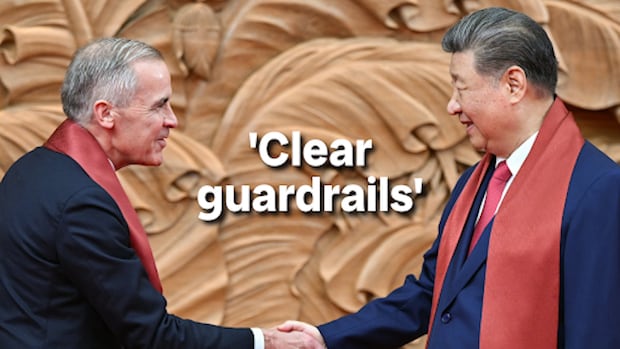
CBC’s Rosemary Barton speaks with Foreign Affairs Minister Anita Anand about how the government is mitigating security risks following her trip to China where Canada’s government extended its trade deal with the country. Plus, lobster fisher Gail Atkinson tells Barton what China’s tariff relief on Canadian lobster could mean for her crew.
Brian Heberlig, a lawyer representing Huawei, stated that the company intends to appeal the convictions but viewed the acquittal on the racketeering charge as a form of vindication.
“That was the singular count that unified all the allegations,” he remarked outside the courtroom, emphasizing that the jury’s decision “discredited the central government narrative in the case.”
‘Economic bullying’
The implications of the verdict for Huawei’s international prospects remain uncertain. The company has been barred from selling equipment to U.S. carriers for several years due to security concerns. Additionally, it has been placed on a blacklist by other Western allies, including Canada and the United Kingdom.
Despite these challenges, Huawei continues to thrive in other markets. Its smartphones and various telecom equipment are distributed globally. Recently, the company has ventured into chip manufacturing, responding to the rising demand for microprocessors driven by the artificial intelligence boom, positioning itself as a viable alternative to chips from companies like Nvidia in China.
The United States initially filed its criminal charges against Huawei in early 2019, subsequently broadening the scope of the allegations.
Chinese officials have accused the United States of engaging in “economic bullying” and misusing national security as a justification to suppress Chinese corporations.
‘You can’t steal a secret that isn’t a secret’
The indictment against Huawei charged the company with a long-standing history of outright theft of technology. Prosecutors claimed that Huawei once marketed internet routers that contained source code taken from a rival. In another instance, a Huawei employee infiltrated a competitor’s booth at a trade show in Chicago to secretly photograph the circuits of another company’s networking device, according to the indictment.
Prosecutors also stated that on another occasion, a Huawei employee took a robotic arm from a competitor’s lab for photography and measurement purposes.
Victim companies mentioned included Cisco Systems, Motorola Solutions, T-Mobile, Quintel USA, and Fujitsu, as per court documents.
“The culture was set at the highest levels by Huawei leaders and executives who engaged in criminal activities, such as lying to Congress, deceiving banks, violating U.S. sanctions, and seeking to obstruct the very criminal investigation that led to this case,” prosecutor Meredith Arfa told the jury during the trial.
During his closing arguments, Huawei’s attorney asserted that prosecutors relied on “innuendo and out-of-context facts,” and testimonies from former employees “with grievances,” to target a company that had achieved success through “hard work, innovation, and competition.”
“Heberlig stated, “Huawei did not steal its way to success,” pointing out that much of the material cited by the U.S. as stolen was already publicly available.
“You cannot steal a secret that isn’t a secret,” he emphasized.
He highlighted that Huawei has spent billions on licensing fees over the years, with 75 percent of those payments going to U.S. firms, and has taken disciplinary action against employees found to have committed misconduct.
Heberlig noted that instances of Cisco source code appearing in Huawei software occurred over two decades ago. When the copying was discovered, Huawei recalled the affected routers sold in the U.S. and offered to replace them with Cisco routers, establishing a “compliance culture that still exists at Huawei today.”
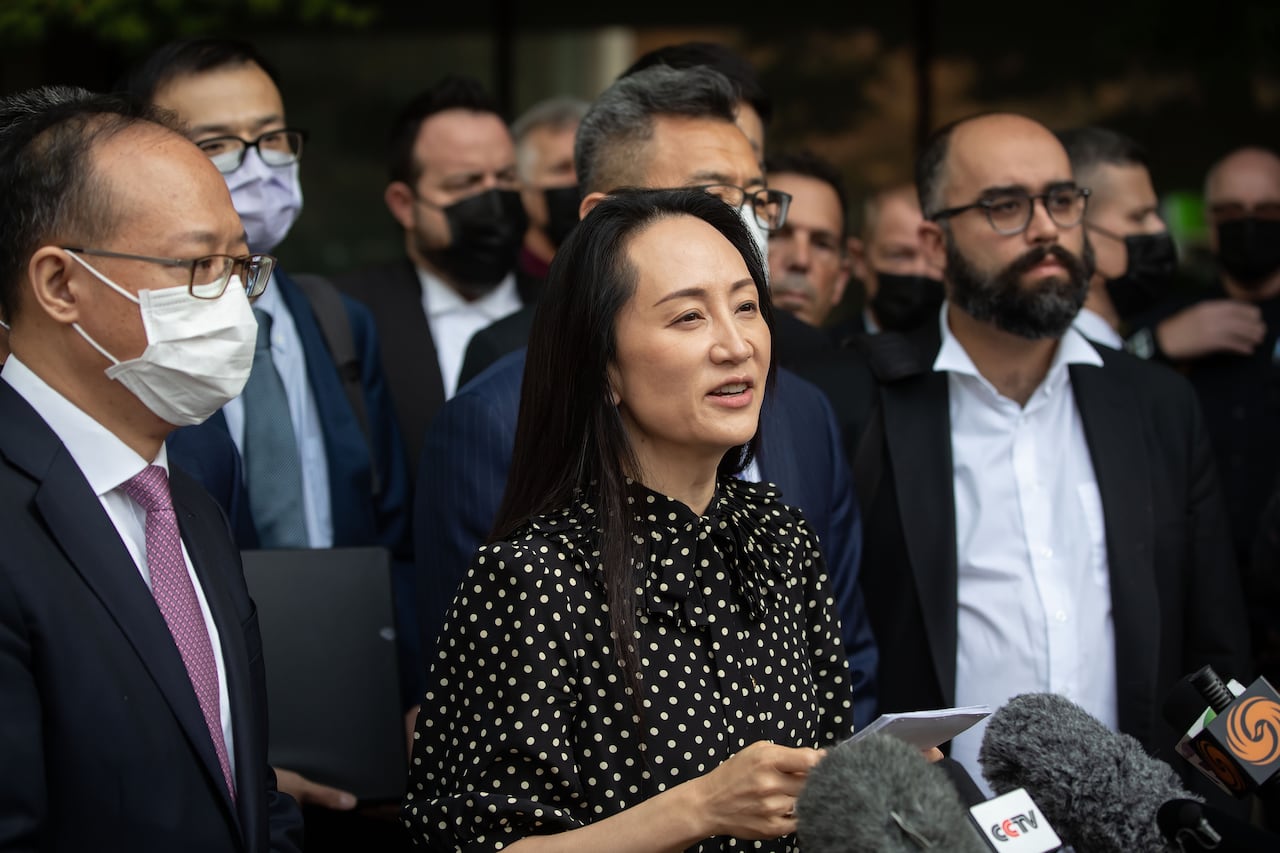
Meng Wanzhou, CFO of Huawei, delivers a statement outside B.C. Supreme Court in Vancouver, September 2021. (Darryl Dyck/The Canadian Press)
U.S. prosecutors had previously filed criminal charges against Huawei’s chief financial officer, Meng Wanzhou, accusing her of misleading HSBC bank regarding the company’s operations in Iran.
Meng, who is the daughter of Huawei’s founder, was detained in Canada in 2018 but ultimately returned to China in 2021 in a prisoner exchange that released two Canadians held in China. As part of this arrangement, the U.S. dropped its case against her.
The trial in New York coincided with a summit involving U.S. President Donald Trump, China’s Xi Jinping, and Russia’s Vladimir Putin in Shenzhen, a city known for its technological focus.