
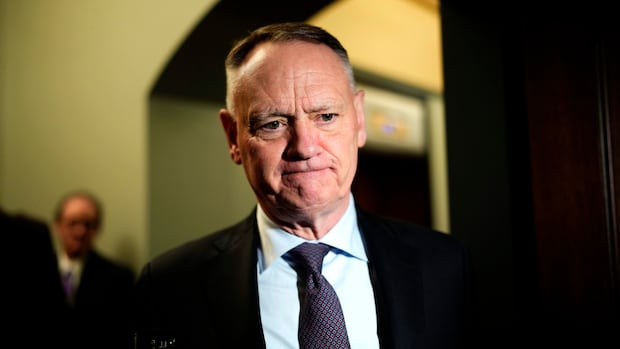


Tensions intensified on Tuesday between the Pentagon and the Canadian government as a high-ranking U.S. defense official cautioned that additional, unspecified actions could be taken if Canada fails to prioritize its military expenditures on safeguarding the continent.
These comments were delivered during a background briefing for Canadian reporters, which received clearance for publication from the U.S. Department of War.
The senior official explained that a careful, measured strategy has been deployed to capture the attention of Canadian officials, beginning with the suspension of the Permanent Joint Board on Defense (PJBD) last spring.
“This was a significant signal, but it hasn’t resolved the issue,” the Defense Department official remarked.
“We are prepared to escalate if necessary. If Canada cannot convincingly convert its defense spending commitments into essential investments for North American security, we will have no option but to consider more significant mitigation strategies.”
While the official did not elaborate on the nature of these potential measures, there was an implied urgency in their tone.
“Prudence requires us to investigate how we safeguard the United States in a scenario where we cannot depend on Canada to effectively prioritize military enhancement and fulfill its obligations within a reasonable timeframe,” the official stated.
“Canada has disregarded many of our concerns, particularly regarding NORAD, for an extended period. Hence, we aim to convey in a credible yet thoughtful manner that the current circumstances are untenable.”
Increasing Pressure
The pressure began to mount over the weekend when a leaked report in The Washington Post revealed that the U.S. military had imposed restrictions on engagements with Canadian forces. On Monday, the Pentagon released a public fact sheet stating that Canada is not seen as a credible defense ally and highlighted deficiencies in Canadian military readiness.
“Canadian political leaders are pursuing unfocused global commitments, leading to personnel and equipment overextension, postponed upgrades for essential assets, and low readiness rates,” the fact sheet indicated.
“Ottawa’s emphasis on narrow economic and commercial interests over military optimization adds further uncertainty for NORAD and imposes additional strain on our Joint Force and the American taxpayer.”
The fact sheet accused Canada of failing to fulfill its NORAD and NATO obligations.
In his background comments, the senior U.S. official asserted that “the disparity between what is said and what is done in Ottawa is the greatest in all of NATO” when it comes to fulfilling commitments to allies.
The official cited Germany as an exemplary ally that swiftly increased its defense spending and is on course to meet its obligations.
Additionally, the official mentioned several European nations that are likely to meet NATO’s goal of five percent of GDP in defense spending by the end of the decade — five years ahead of the timeline established by allies last year.
“Canada has an exceptionally long journey ahead,” the senior official remarked. “We appreciate the modest advancements so far, but we require significantly more credibility regarding spending commitments.”
As he entered cabinet on Tuesday, Defense Minister David McGuinty faced numerous inquiries regarding the Pentagon’s fact sheet.
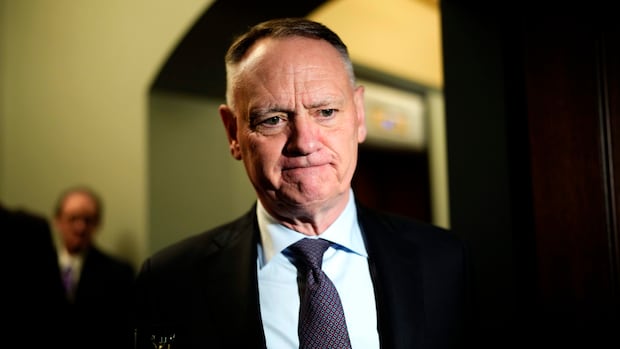
Following the Pentagon’s release of a fact sheet that criticized Canada’s defense expenditures and military readiness, Defense Minister David McGuinty insists that military cooperation between the nations is proceeding as usual.
“Canada is a sovereign country. To be clear: We do not answer to the United States,” McGuinty asserted.
He highlighted the recent federal budget, which outlined a trajectory for defense spending to reach four percent of GDP by 2030.
In the fact sheet released on Monday, the Pentagon indicated that Canada must clarify how it intends to achieve the five percent target.
The federal budget was ambiguous regarding spending beyond 2030, and both McGuinty and Prime Minister Mark Carney noted that much will hinge on NATO’s forthcoming review of the target in 2029.
Kerry Buck, former NATO ambassador for Canada, remarked that there are evidently more factors influencing the Pentagon’s grievances than just defense spending.
She acknowledged the U.S. worries regarding Canada’s military readiness and its implications for NORAD, but emphasized that years of underfunding will not be resolved overnight.
The fact that Carney is moving Canada closer to Europe and prioritizing acquiring military equipment from non-U.S. suppliers appears to underlie some of the arguments she perceives.
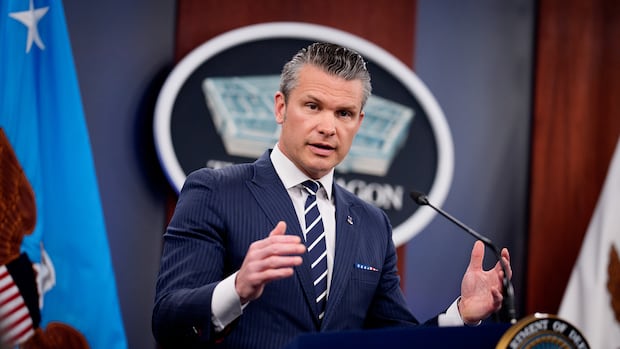
The Pentagon publicly released a ‘fact sheet’ criticizing Canada’s defence spending and military readiness, stating the country isn’t meeting its obligations to NORAD or NATO.
“Perhaps the U.S. concerns extend beyond our NATO activities,” Buck suggested. “It could be that the U.S. complaints are connected to our shifting focus and the move away from an overdependence on the U.S. military, including purchasing from American sources.”
Steve Saideman, a defense scholar at Carleton University, recognized that military readiness is indeed a concern in Canada, but he believes U.S. domestic politics are influencing the situation.
“This situation revolves around [U.S. Secretary of War] Pete Hegseth,” Saideman remarked. “He’s attempting to project a strong image … intimidating allies rather than actually addressing his own domestic challenges.”
In Washington, Hegseth is under significant scrutiny from Congress and has recently survived a bipartisan impeachment attempt.
This pressure is expected to grow further as Democrats take control of both the U.S. House of Representatives and Senate in the upcoming year.