
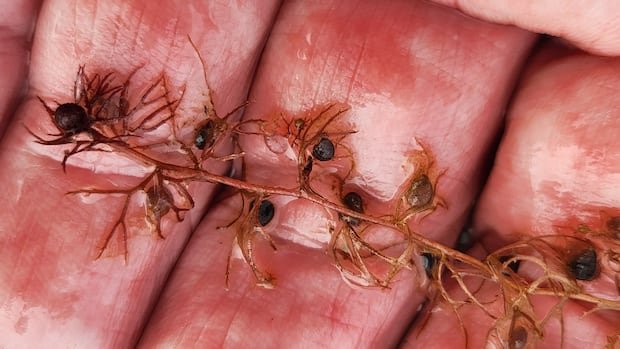


Plant enthusiast Klaus Koehler made a unique discovery in July while wandering through Sylvia Grinnell Territorial Park near Iqaluit. He stumbled upon a seldom-seen plant species in the Arctic, known as bladderwort. Koehler emphasized the significance of this find in relation to the potential spread of invasive species in Northern environments as a result of climate change.
Describing the plant as inconspicuous to the untrained eye, Koehler extracted a brownish weed-like bladderwort from a pond during his excursion. The carnivorous plant is adorned with small black bladders containing partially digested flies, a trait not commonly observed in the tundra, as it typically thrives in more temperate regions.
The only previous sighting of bladderwort in the area dates back to 2012 when a research team discovered samples near Kimmirut, approximately 120 kilometers southwest of Iqaluit. This observation was documented in the scientific journal Phytokeys. During three expeditions to the Arctic, the team identified over 30 previously undocumented plant species in the Arctic archipelago.
Koehler theorizes that the emergence of bladderwort signifies a changing climate. While the Arctic has historically harbored few invasive species due to the harsh conditions, the warming environment is now fostering conditions conducive to the growth of plants not traditionally found in the region. This shift is expected to alter the local ecosystem, with vegetation expanding due to longer summers and milder winters.
Paul Sokoloff, a senior research assistant at Ottawa’s Museum of Nature and a member of the 2012 discovery team, shares concerns about this ecological transformation. He highlights the potential introduction of plant species by birds, cargo ships, and human visitors to the Arctic, emphasizing the need to prevent non-native plants from outcompeting indigenous flora.
Sokoloff draws attention to the threat posed by invasive species, citing the example of Phragmites, a Eurasian grass that has wreaked havoc on Ontario’s ecosystem. While Koehler’s find is not expected to have a similarly damaging impact, Sokoloff warns of the potential invasion of over 2,500 plant species into the Arctic, jeopardizing the native biodiversity.
Koehler intends to submit a sample of the Iqaluit bladderwort to the Museum of Nature for further analysis, aiming to enhance scientific understanding of the plant’s northward expansion and its implications for the Arctic environment.