
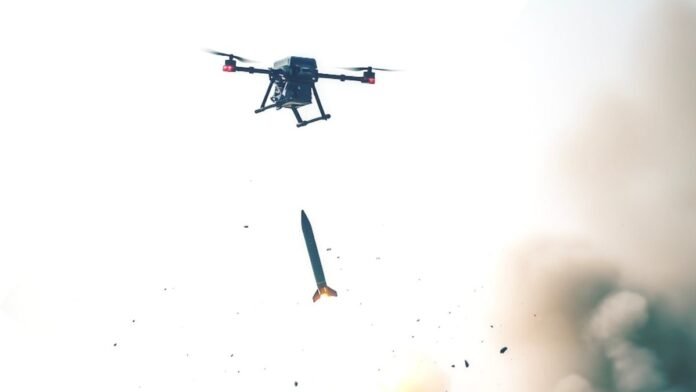


Fighting against Russian advancements in Europe, a diminutive missile known as the “Mark 1” is proving to be a potent weapon. Produced by Estonian company Frankenburg Technology, this compact missile, measuring 65cm in length, is designed to target Russian drones infiltrating European airspace.
Marketed as tailor-made for countering the specific drones utilized by Russian forces, the Mark 1 is equipped with solid rocket propellant and autonomous guidance systems. It is primed to intercept unmanned aerial vehicles such as the Iranian-made Shahed-131 and Shahed-136 models, commonly employed by Russia in its incursions.
The missiles are engineered to detonate a warhead within a range of about two kilometers from the target, effectively neutralizing threats at a safe distance. Scheduled for distribution across Europe in the coming months, these missiles are anticipated to play a crucial role in safeguarding against Russian drone activities.
Kusti Salm, the CEO of Frankenburg Technology, emphasized the critical importance of this weaponry in countering Russian incursions. Highlighting the necessity of such capabilities in the Western world, particularly in light of recent territorial violations, he underscored the strategic significance of these advanced missile systems.
European nations have faced mounting challenges from Russian drones breaching borders, prompting responses from organizations like NATO. While costly jet defenses have been deployed by the West, Russia has exploited cost-effective munitions, escalating tensions in the region.
Recent incidents, such as drones near Brussels airport on November 6, have underscored the urgency of bolstering defenses against aerial threats. With calls for closer alliances and collective defense strategies, military leaders are advocating for enhanced cooperation to safeguard critical infrastructure and airspace.