
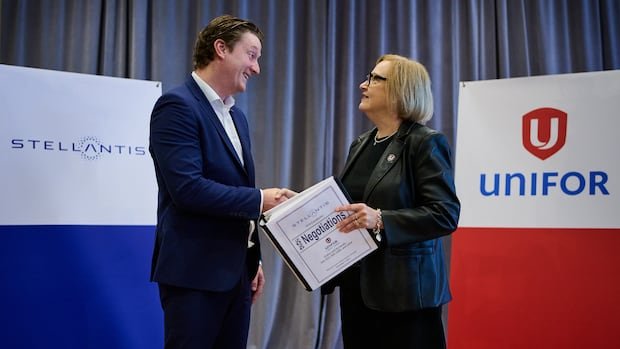


The labor union representing workers at Stellantis issued a caution to the U.S. automaker regarding the treatment of Canadian employees as Unifor and the company initiated contract discussions on Tuesday.
These negotiations signify the final phase of bargaining between Unifor and the Detroit Three automakers. The union usually employs pattern bargaining during auto sector negotiations to establish terms that it aims to replicate with other firms.
Although Unifor recently ratified new collective agreements with Ford Motor Co. and General Motors in Canada, its national president Lana Payne stated that the biggest challenge lies ahead.
“Given the current circumstances, uncertainties, tariffs, and trade disputes under the previous administration, we have surpassed expectations,” she mentioned during a press briefing. “However, let’s be realistic. We anticipate that this round of negotiations will be our toughest and most demanding yet, perhaps ever.”
The deadline for reaching a new agreement is set for September 11, with the union emphasizing job security as a primary concern following the layoffs of over 2,000 workers from Stellantis’ Brampton assembly plant, which has been inactive since 2023.
Last month, the union received notification of Stellantis considering the closure and sale of the plant. The site was initially planned for Jeep production, a process that commenced in early 2024 but was halted by the company in early 2025.
Subsequently, the decision to relocate production of the Jeep Compass to the U.S., as per the union, was deemed a breach of the existing collective agreement, resulting in the indefinite idling of the plant.
In a previous announcement, Payne disclosed that Stellantis might shut down and sell the facility, although a formal written notice was not provided to the union, as required under the current agreement.
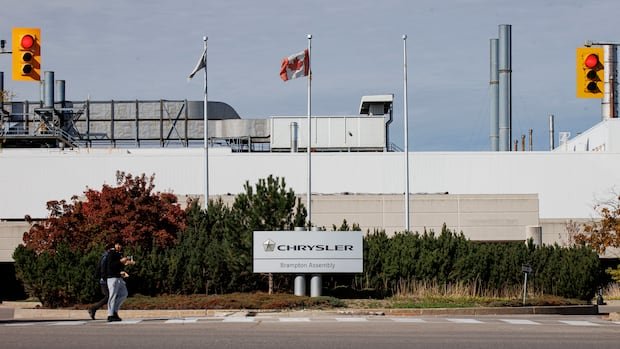
Unifor says it received information from Stellantis on Wednesday about plans to possibly close or sell the Brampton plant. CBC Dale Manucdoc breaks down what we know.
Reiterating her stance, Payne insisted that the relocation of Jeep Compass production from the Brampton plant was an incorrect decision.
“Frankly, the transfer of Jeep Compass production should not have occurred at the Brampton plant,” she emphasized. “Stellantis has significant ground to cover to mend relationships with our members and the Canadian populace.”
Stellantis highlighted the importance of