
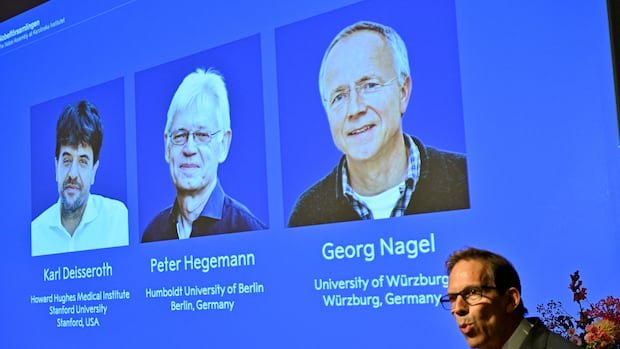


Three scientists, Karl Deisseroth, Peter Hegemann, and Georg Nagel, were awarded the 2026 Nobel Prize in Physiology or Medicine for their groundbreaking work on light-gated ion channels and optogenetics, as announced by the Nobel Assembly in Stockholm on Monday. Optogenetics allows for the precise control of individual nerve cells’ activity in a live brain, revealing previously unknown insights into the brain’s functions, shared Thomas Perlmann, the secretary general of the Nobel Assembly at Karolinska Institutet.
The laureates, Deisseroth from the U.S., Hegemann, and Nagel from Germany, expressed their delight at receiving the prestigious award together. They emphasized the honor of sharing the recognition with each other, highlighting their camaraderie and collaborative efforts. The Nobel Prize carries a monetary award of 12 million Swedish crowns, which the three scientists will divide among themselves. Deisseroth is affiliated with Stanford University, Hegemann with Humboldt University in Berlin, and Nagel with the University of Würzburg in Germany.
The impact of optogenetics in neuroscience has been profound, marking the beginning of a new era in understanding brain functions. Researchers are exploring applications of optogenetics in restoring vision to individuals affected by retinitis pigmentosa and enhancing cochlear implants for more precise stimulation of the auditory nerve compared to traditional methods.
The pioneering work in optogenetics began in the early 1990s when Hegemann and Nagel discovered channelrhodopsin-2, an ion channel sensitive to light, by studying the alga Chlamydomonas. Deisseroth further developed this technique, demonstrating its effectiveness in rat nerve cells, leading to the formalization of optogenetics as a method in 2006.
Deisseroth, originally interested in neurosurgery, shifted his focus to psychiatry to delve into understanding conditions like depression and autism. The Nobel Prizes for chemistry and physics are set to be awarded in the coming days, followed by literature and peace prizes later in the week, with the economics prize announcement scheduled for October 12. The Nobel Prize, established by Alfred Nobel, a Swedish chemist and entrepreneur, aims to recognize individuals who have made significant contributions for the betterment of humanity. Nobel’s diverse interests are reflected in the five original prize categories, honoring advancements that benefit society.
The laureates will receive their Nobel Prizes on December 10, the anniversary of Alfred Nobel’s passing, in recognition of their outstanding achievements in the field of medicine and physiology.