
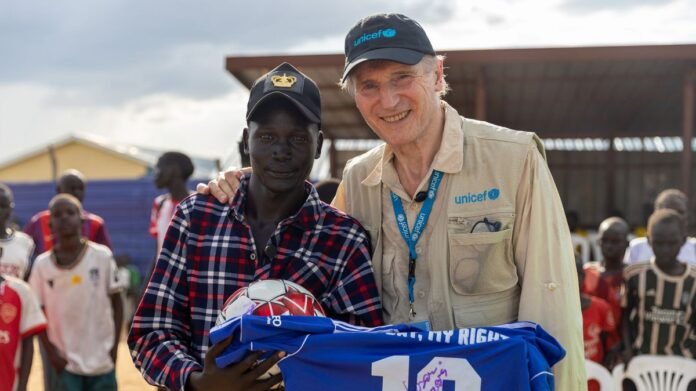


Hollywood star Liam Neeson has expressed his dismay over aid reductions to impoverished nations following his recent trip to South Sudan. Neeson, serving as a UNICEF Goodwill Ambassador, spent six days in the country, engaging with mothers of children confronting starvation.
Approximately 2.3 million children in the conflict-affected nation are presently in danger of severe malnutrition, with almost half of them facing potential death without immediate intervention. However, budget cuts by wealthier countries have led to the shutdown of 186 nutrition treatment centers, depriving vulnerable families of crucial support.
Neeson voiced his distress, stating, “The sight of numerous malnourished children deeply saddened me. Instead of laughter, they were eerily quiet; instead of play, they were asleep; and instead of smiles, they cried. As treatment facilities are shutting down nationwide, I fear for the future of these children.”
UNICEF is anticipating a 20% decrease in funding over the next four years, resulting in only five social workers available for every 100,000 children. Neeson, who also encountered young girls coerced into marriage, emphasized, “The global community must not forsake children like those I met in South Sudan. Decreases in funding jeopardize critical life-saving initiatives for children worldwide. We must choose to support them now or witness their prospects slip away.”
UNICEF is actively working in South Sudan to address severe malnutrition in children and implement preventive measures such as enhancing diets and providing supplements to expectant mothers.
Reflecting on his visit to South Sudan, Liam shared, “In Bor, Jonglei State, I met Ajier, mother of seven-month-old Lual Malek. She sought help at the nutrition center after a community volunteer noticed Lual’s weight loss. Following admission to the outpatient program, Lual has shown weight gain after three weeks. It is evident that this intervention is effective – volunteer mothers in villages are identifying and referring mothers whose children require assistance. Ajier and numerous other mothers I encountered were unequivocal: without these programs, their children would not have survived.”
Additionally, Liam interacted with individuals who had been victims of child marriage or recruited into gangs in the region. According to UNICEF, 50% of girls are at risk of child marriage, and 75% of girls and women are likely to experience gender-based violence in their lifetime.