
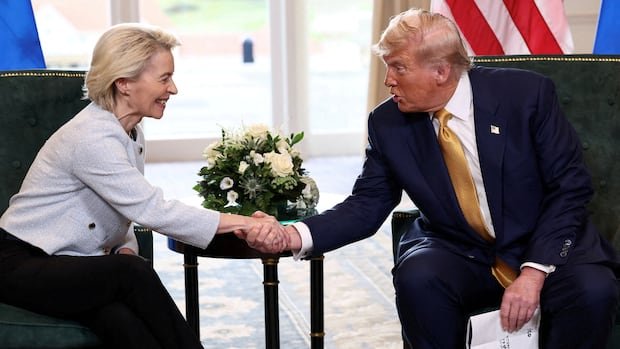


European Union President Ursula von der Leyen made assurances to Europeans last year during a visit to Donald Trump’s Turnberry golf resort in Scotland that agreeing to a flat 15 per cent U.S. tariff on EU exports would bring “predictability and stability” to the continent. However, some critics now view the trade deal as a one-sided surrender that has led to ongoing American economic pressure on Europe.
The initial U.S. actions included attempts to reclassify certain European industrial goods for higher tariffs. The latest conflict arises from European plans to impose a digital services tax on U.S. tech giants, mirroring Washington’s efforts to dictate tax terms to Ottawa. Following the ratification of the Turnberry deal by the European Parliament, Trump threatened to impose 100 per cent tariffs on any European country that enforces or expands tech taxes.
As European resistance to Trump’s demands grows, lawmakers are observing Mark Carney’s departure from U.S. trade negotiations as a model for confronting aggression. Former French ambassador Gerard Araud suggested that Canada’s firm stance against Trump’s demands should guide the EU, emphasizing the importance of unity among democratic nations.
While Europe has been hesitant to challenge Trump on trade matters, the region has taken a strong stance against territorial disputes. The attempted coercion of Denmark by Trump over Greenland’s sovereignty faced widespread condemnation, leading to diplomatic tensions and military responses.
Britain’s pursuit of trade stability with Trump has yielded disappointing results, with the country facing tariffs and loss of competitiveness due to the U.S. offering similar deals to other nations. The threat of 100 per cent tariffs over the digital services tax forced British officials to reconsider their position, highlighting the challenges of negotiating with the current U.S. administration.
Trade experts caution that replicating Canada’s approach may be challenging for Europe and the UK due to differences in public support and economic resilience. The erosion of political will in the face of prolonged conflicts with the U.S. underscores the need for careful negotiation strategies and long-term considerations.
Despite declining confidence in Trump’s leadership globally, there remains hope for future trade negotiations to yield positive outcomes. The history of trade talks is marked by setbacks and eventual resolutions, emphasizing the potential for successful agreements after initial challenges.