
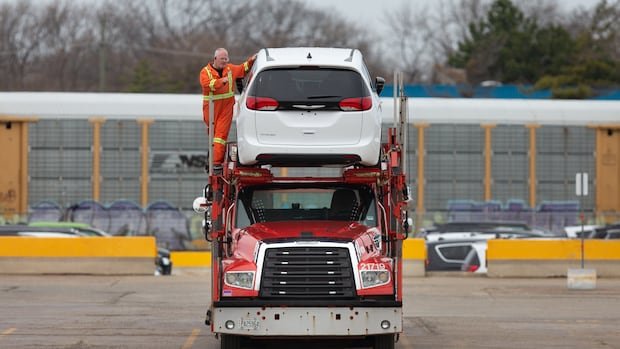


U.S. President Donald Trump’s trade ambassador recently made remarks regarding Canada’s auto industry, indicating that its integration across North America could be a significant issue if negotiations resume. Trump and U.S. Commerce Secretary Howard Lutnick have emphasized their desire for Canadian auto manufacturing jobs to relocate to the United States.
In an exclusive interview with CBC News, U.S. Trade Representative Jamieson Greer discussed the future of the integrated auto sector between the U.S. and Canada. Greer highlighted the gap in manufacturing employment in the U.S., particularly in the auto sector. He expressed concerns about the negative impact of globalization on states like Michigan, Ohio, Pennsylvania, and Wisconsin.
Regarding the Trump administration’s objective, Greer clarified that the focus is on “re-industrializing” in general, rather than specifically targeting auto manufacturing in Canada. While acknowledging Canadian aspirations to expand concessions, Greer emphasized prioritizing actions beneficial to America while accommodating Canada to a reasonable extent.
Mark Wiseman, Canada’s ambassador to the U.S., emphasized the importance of protecting the auto industry for Canada’s economic stability, particularly in Ontario and Quebec. Greer, who led the unsuccessful trade talks, mentioned that unresolved issues included U.S. tariffs on finished vehicles and Canadian auto parts.
Canadian negotiators aimed to reduce tariffs, but disagreements arose over excluding certain heavy- and medium-sized trucks. Greer clarified that the duties on these trucks were separate from the proposed auto tariffs. Despite the breakdown in negotiations, industry experts remain optimistic about the potential for a future deal and urge both nations to resume discussions to avoid escalating trade tensions.
The Canadian automotive industry plays a crucial role in the North American market, with stakeholders emphasizing the need for collaboration and mutual benefits. Despite challenges, there is hope for a resolution that safeguards the interests of both countries and sustains the competitiveness of the auto sector.