
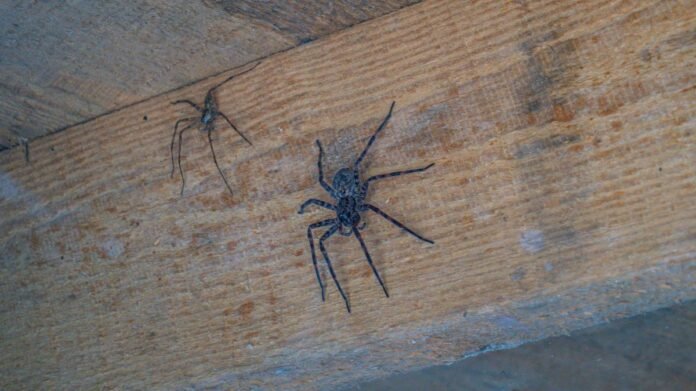


A family in Kansas unknowingly cohabited with more than 2,000 spiders for over five years, with a surprising revelation by scientists. The residence in Kansas harbored a total of 2,055 brown recluse spiders, with approximately 400 of them possessing venom. While certain spiders can be beneficial in a household, others pose significant risks.
Initially, the family sporadically observed spiders in their home but only recognized them as venomous brown recluse spiders five years after moving in. Subsequently, pest control professionals were summoned to capture the spiders. Upon investigation, researchers were astonished to find that despite the prolonged coexistence, none of the residents had been bitten.
Brown recluse spiders are venomous, but their bites typically result in temporary blistering or swelling that resolves within a week. According to IFLScience, once these spiders establish in a house, they are challenging to eradicate due to their adeptness at hiding in furniture and inconspicuous nooks.
Furthermore, these creatures can survive for extended periods without feeding, with female spiders requiring only one mating encounter to continuously reproduce over their lifespan. The household in Kansas only became aware of the infestation in 2001, despite residing there for more than five years.
Initially mistaken for harmless insects, the spiders were later identified as brown recluse species by pest control experts. Over a period of six months, a total of 2,055 spiders were captured, primarily comprising small spiders, many of which were presumed to be young. Typically, brown recluse spiders do not exhibit venomous traits until they reach around 5mm in size.
A study published in the Journal of Medical Entomology indicated that the heavily infested dwelling contained an estimated 488 venomous spiders. Surprisingly, the family members had not been bitten and remained unharmed throughout the infestation. The study revealed that despite the presence of around 400 potentially venomous spiders, no one in the household suffered any bites.
The research also highlighted a similar case in Chile where a family coexisted with numerous spiders without experiencing bites. This led to the conclusion that dermatological conditions are occasionally misdiagnosed as spider bites, particularly in regions where spider encounters are uncommon.