


In the lobby of a tall building on Fifth Avenue, under a ceiling that appeared to be sun-kissed, I witnessed the entry of a reality TV star into the realm of American politics via a golden escalator.
Back in June 2015, few fully comprehended the potential threat posed by Donald Trump. It wasn’t just a show; it was a strategic unveiling of a dangerous agenda. When he announced his presidential bid, he portrayed migrants as criminals and painted grievances as acts of patriotism. The whole scenario felt like a scripted drama, almost surreal, with the host of “The Apprentice” transitioning seamlessly into a political campaign.
However, this wasn’t merely theater; it marked the beginning of a calculated political offensive rooted in division, fueled by spectacle, and aimed at perpetuating confrontation. The repercussions of this strategy continue to reverberate globally, reaching even places like South East Manchester.
Since that pivotal moment, Trump has honed a playbook that reshaped modern populism. He positioned himself as the advocate for the overlooked “forgotten” Americans while vilifying courts, journalists, and public servants as corrupt adversaries. His narrative spun a tale of a battle between “the people” and a supposedly decadent elite. Immigration transformed from a policy issue into a cultural battleground, where a border wall became a potent symbol and deportations turned into a display of strength.
Despite promising to uplift working families’ dignity, Trump’s major legislative accomplishments favored corporations and the wealthy disproportionately. His billionaire associates thrived, some even evading justice, while many workers struggled to keep pace with rising living costs, if they managed to retain their jobs at all.
Simultaneously, trade wars erupted under the guise of safeguarding domestic industries, tariffs were imposed, and international alliances strained under the “America First” banner. Every setback was attributed to external forces, every critique labeled as sabotage, and those pointing out flaws branded as enemies. Loyalty trumped expertise, and division became the guiding principle of governance, yielding effective results.
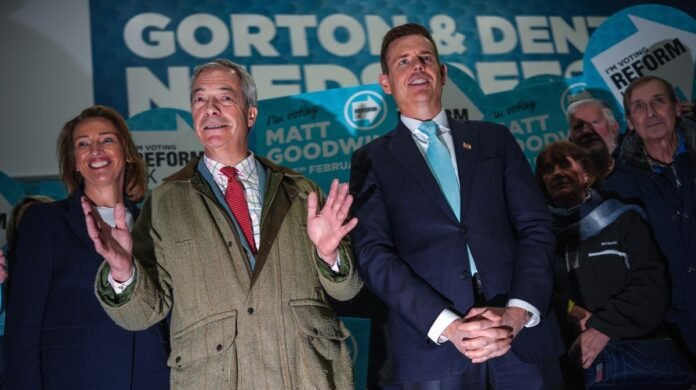
This trend should sound alarm bells for voters in Gorton and Denton, as they head to the polls not just to pick between political parties but to determine if a similar brand of politics, rooted in grievances, confrontation, and personality cults, gains a stronger foothold in their communities.
The parallels between Trump’s tactics and the strategies endorsed by Nigel Farage and Reform UK are striking. Farage openly admires the US president, emulating his rhetoric and approach. Farage’s team, including figures like Zia Yusuf and Richard Tice, mirrors a similar methodology, emphasizing political opportunity over policy nuances.
Farage’s outsider persona, criticizing establishment elites, resonates with Trump’s approach, particularly in framing Brexit as a battle for sovereignty against distant bureaucrats. Both emphasize national sovereignty, disdain for global institutions, and champion protectionist economic policies as solutions to complex challenges.
Furthermore, both Trump and Farage advocate for deregulation, tax cuts, and fossil fuel expansion, all under the guise of economic freedom and protection from global forces that supposedly disadvantage ordinary citizens.
Yet, beyond policy alignment, the most concerning aspect lies in their shared tone of provocation, where controversy becomes a tool, social media a weapon, and politics a performance. The emphasis on personality over policy substance, loyalty over detail, and division as a unifying force mirrors a dangerous path towards polarization and institutional erosion.
The UK’s parliamentary system may differ from the US presidential model, but the normalization of divisive rhetoric and anger as the foundation of political discourse can still reshape the national culture. The voters in Gorton and Denton face a critical decision, not just about a candidate but about the trajectory of their political landscape and the values they wish to uphold.
History has shown that while grievance may win elections, governing effectively in a polarized environment poses significant challenges, often resulting in policies that benefit the privileged few under the guise of populism. As Reform UK presents itself as the voice of the ordinary citizen, voters must scrutinize whether its economic agenda truly serves the interests of all and whether its divisive rhetoric fosters unity or further division.
The vote in Gorton and Denton transcends local boundaries; it serves as a signal for the nation’s stance on confrontational politics versus stability. The electorate must weigh the consequences of disruption and ensure that the direction chosen aligns with principles of cohesion, fairness, and unity, rejecting imported outrage in favor of a more inclusive and harmonious future.