
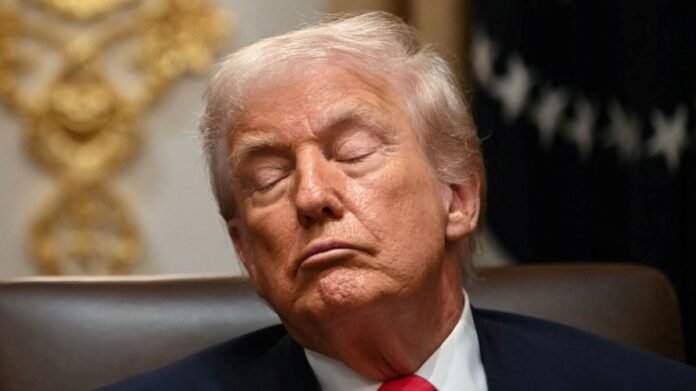


Over an extended period, Donald Trump consistently used age and mental acuity as key aspects of his political strategy. He frequently ridiculed Joe Biden, employing derogatory nicknames to convey the message that Biden was aged, confused, and unsuitable for his role. Trump not only questioned Biden’s endurance but also turned it into a regular spectacle.
Now, with Trump himself back in power at the age of 79, attention has shifted away from Biden. Instead, the focus is on whether Trump is displaying more concerning behavior than the individual he previously criticized. Worries regarding the president’s mental well-being are no longer limited to social media or political attacks but are now being quietly raised by diplomats, allies, and officials who have interacted with him directly.
Reports indicate that concerns about Trump’s health are increasingly being discussed across European capitals at various levels. This development alone should raise significant concerns.
Notably, Slovak Prime Minister Robert Fico, a political supporter of Trump known for echoing his criticisms of Europe, expressed apprehensions about Trump’s “psychological state” after a recent meeting with the US leader. Diplomats present described Fico as “shocked,” with some stating that Fico went as far as to characterize Trump as “out of his mind,” while others mentioned that Fico seemed “traumatized” by the encounter. This sentiment was not isolated.
During a White House meeting with executives from the fossil fuel industry earlier this year, Trump’s attention drifted towards his ballroom construction project, leading him to abruptly shift focus and remark on the view from a window. This incident, observed by Vice President JD Vance and Secretary of State Marco Rubio, highlighted a concerning pattern of Trump losing concentration during critical discussions, rather than showcasing it as a political performance.
Instances of Trump dozing off during important meetings, even in the presence of world leaders, have also been noted. While individual occurrences of fatigue are not uncommon, the repeated nature of these incidents, coupled with increased irritability, incoherent speech, and apparent memory lapses, suggest a more troubling pattern that cannot be dismissed as mere eccentricity.
Physically, there are also disconcerting signs. Trump’s swollen ankles and frequently bruised hands have raised eyebrows. The White House has attributed the bruising to excessive handshakes and long-term aspirin use, citing a diagnosis of chronic venous insufficiency, a condition common among older adults affecting blood flow.
While these factors do not definitively indicate mental decline, collectively, they emphasize a fundamental truth that Trump previously emphasized about Biden: age and health play crucial roles, especially in contexts involving nuclear capabilities and global stability.
The current situation is made more poignant by Trump’s own history of mocking Biden’s lapses. While he once demanded cognitive tests and encouraged public laughter at Biden’s expense, the tables have now turned as Trump faces similar, if not more severe, scrutiny for his own actions. There is a noted shift in Trump’s temperament, with allies describing him as increasingly volatile, distracted, and prone to outbursts of anger.
His recent threats, such as the proposal to acquire Greenland or disrupt alliances, are viewed not