
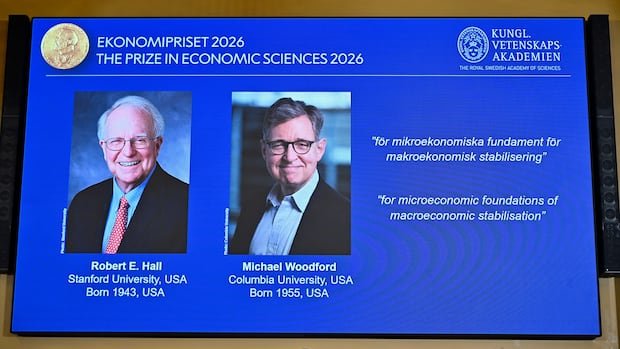


American economists Robert E. Hall and Michael Woodford, both born in the U.S., were awarded the Nobel Prize in Economics by the Royal Swedish Academy of Sciences in Stockholm. Their groundbreaking research on economic models that assist governments and central banks in managing economic shocks was recognized.
The Academy highlighted that the laureates’ work has been instrumental in smoothing out economic fluctuations and providing policymakers with tools to address economic challenges effectively. Hall is associated with Stanford University in California, while Woodford is linked with Columbia University in New York.
Upon receiving the prestigious award, Woodford expressed his surprise and gratitude, acknowledging the honor. John Hassler, the chair of the Committee for the Prize in Economic Sciences, emphasized the significant impact of the laureates’ work in establishing a robust theoretical foundation for economic models utilized globally.
The economists’ contributions have enhanced the understanding of how consumers and businesses make decisions regarding investments and spending, leading to improved methods for managing economic stability. Their research has revolutionized stabilization policy, addressing the limitations of previous approaches, such as the Keynesian model, particularly evident during the stagflation era of the 1970s.
The Nobel Prize in Economics, formally known as the Bank of Sweden Prize in Economic Sciences in Memory of Alfred Nobel, was established in 1968. Although technically not a Nobel Prize, it is awarded annually alongside the traditional Nobel Prizes on December 10th, Nobel’s death anniversary. This year’s prize money amounts to 12 million Swedish kronor (approximately $1.7 million Cdn) and is granted to individuals, small groups, or organizations.
The recent Nobel laureates join the ranks of distinguished researchers and luminaries across various fields, including medicine, physics, chemistry, literature, and peace, who were also honored in separate categories.