
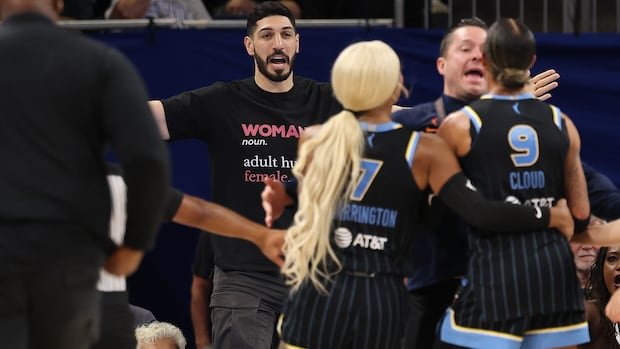


On a heated Sunday night at Wintrust Arena, the Chicago Sky faced off against the Indiana Fever in a game dominated by the Fever, who won 113-90 with Caitlin Clark leading the charge. The buzz surrounding this game doesn’t just stem from the excitement of women’s basketball but also from the actions of former NBA player Enes Kanter Freedom, who engaged in a verbal altercation with the Sky’s Natasha Cloud near the court’s baseline.
Natasha Cloud, a prominent and vocal player known for her stance on social justice issues, found herself in a confrontation with Freedom, resulting in his ejection from the arena. Freedom’s actions during the game raised questions about his motives, as he appeared to be delving into a debate about transgender women in the WNBA, despite the absence of openly transgender players in the league.
Sporting a shirt that read “Woman 🔊noun. Adult human female,” Freedom attempted to make a statement about biological females, positioning himself as an authority on the matter. Meanwhile, Cloud, who was named player of the game, expressed concerns about being a distraction, although her coach reassured her of the team’s support.
Freedom’s attempt to draw attention to women’s sports by creating controversy and leveraging social media engagement through disruptive actions has been met with skepticism. While he has tried to position himself as a defender of women’s sports, his recent actions, including declaring himself for the 2027 WNBA draft alongside another former player, Royce White, have been viewed as publicity stunts.
Despite Freedom’s self-proclaimed advocacy for women’s sports, his eligibility to play in the WNBA has been questioned, with reports indicating that he would not meet the league’s criteria. His presence at the game between the Sky and the Fever, coinciding with guard Sophie Cunningham’s involvement, seemed orchestrated to fuel the ongoing controversy.
Men inserting themselves into discussions about women’s sports is not uncommon, and Freedom’s actions, provoking players and communities with his attire and behavior, align with a pattern observed in individuals purporting to champion women’s sports while undermining its integrity.
The recent interactions involving players like Clark and Cunningham highlight the polarizing debates surrounding inclusion in women’s sports, with opposing views clashing both on and off the court. As the discourse intensifies, the importance of genuine advocacy for women’s sports and inclusion becomes increasingly paramount.
In the midst of these debates, it is crucial to prioritize genuine support for women’s sports and the athletes who dedicate themselves to their craft. As the community navigates these complex discussions, it is essential to uphold the values of inclusivity and respect within the sporting world.