
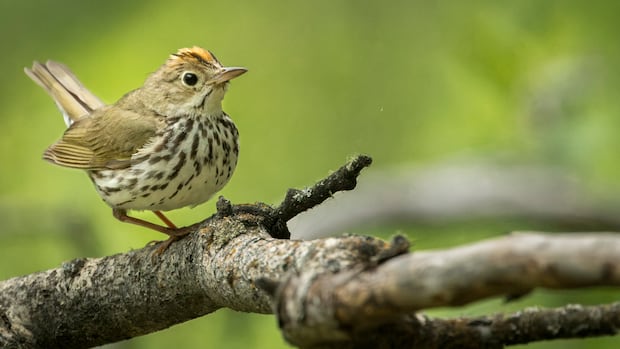


From chirps to melodic tunes, avian vocalizations can be as varied as an orchestral performance.
However, ovenbirds — stout, terrestrial warblers — have a very restricted song repertoire.
The male ovenbird sings just one song: a quick melody often referred to as teacher-teacher-teacher.
While to many listeners, all ovenbirds may seem identical in song, each possesses its unique variation.
Currently, biologists are utilizing artificial intelligence to monitor the well-being of ovenbird populations based solely on their characteristic songs.
A study recently published in the science journal Nature Methods employed AI to recognize individual ovenbirds through recordings obtained from Alberta and Pennsylvania.
Focused on a single song
The ovenbird’s “specific” song selection made it an ideal candidate for research, according to lead investigator Sam Lapp, a postdoctoral researcher at the University of Colorado.
“They are quite dedicated to performing one particular song,” Lapp explained during a discussion with CBC News.
“Many birds develop a vocal signature throughout their lives, often incorporating various songs into what we define as their repertoire.
“However, the ovenbird is unique in that it not only maintains one stable song over time but also sings only a single variation of that song.”
Ovenbirds perform their main song in the spring to establish territory and attract mates, maintaining this refrain throughout their lives.
Under Lapp’s guidance during his tenure with the Department of Biological Sciences at the University of Pittsburgh, the research team utilized recordings amassed from nearly 130 locations in Pennsylvania over a span of four years.
They trained an AI model to identify unique song features and group similar songs together, based on the assumption that each bird would return to the same forest area each spring.
The team analyzed 9,072 hours of audio to monitor 405 individual birds. The researchers subsequently evaluated the model against another set of recordings gathered in the mixed wood and boreal forests of Alberta during the spring breeding season of 2016.
Lapp mentioned that the model could connect songs to individual birds with an impressive accuracy rate of up to 96 percent.
This method is significantly less labor-intensive than traditional leg banding, which involves capturing birds, carefully attaching markers to their legs, and then attempting to recapture them the following spring.
Lapp indicated that the research initiative stemmed from a partnership with Alberta biologists who were trying to determine the locations of birds across large areas using a network of microphones.
Astonishing discoveries
According to Lapp, humans are unable to discern individual ovenbirds in real time, as their vocal differences occur too swiftly.
However, when viewed on spectrographs — graphical illustrations of sound — the unique song of each bird becomes apparent, Lapp noted.
“I began to wonder if my eyes could recognize these patterns, could we train a machine to identify these patterns and automate individual recognition?”
“Even for those who are passionate about birds and keen on identifying species, it’s astonishing and thrilling to realize that this level of information exists, but we’ve simply been overlooking it… provided you’re listening closely enough.”
Erin Bayne, a biology professor at the University of Alberta and co-author of the study, has been attentively observing ovenbirds for years and is familiar with the challenges of annual population assessments.
During his doctoral studies, Bayne spent countless hours tracking banded birds, enabling him to differentiate individuals based on their distinctive vocal variations.
“What that bird over there is saying is slightly different from what that one over there is saying,” he remarked. “I could identify each one.
“They sing with remarkable politeness. It’s quite amusing, actually. One bird will sing, and then the other will wait for it to finish before immediately responding.”
Birds communicate with each other
Bayne stated that the research illustrates that bird communication is much more intricate than most people realize, and that conversations are occurring, even if we fail to comprehend the language.
Just as humans exhibit unique speech patterns, biologists are uncovering how certain animals also develop their distinct vocal identities, Bayne explained.
“It’s not surprising that individual birds or animals have identifiable differences. The more we investigate, the easier it will be to see that this is indeed the case.”
While the AI model has its constraints, the study’s authors hope it offers a less invasive method for assessing the health of songbird populations simply by listening.
The AI cannot effectively track the varied calls of female ovenbirds or the basic sounds produced by young birds.
The current system would also be inadequate for monitoring species such as magpies and mockingbirds, which frequently imitate new sounds or exhibit numerous different songs.
It would be most effective for birds that continuously sing a single, unchanging song throughout their lives — approximately 30 percent of songbird species — as well as certain species of bats and owls.
The researchers made the program code available on open-source platforms to assist other biologists in tracking the survival of additional songbird populations or even other species.
Richard Hedley, a statistical ecologist with the Alberta Biodiversity Monitoring Institute who did not participate in the research, remarked on its significant potential.
Although AI acoustic monitoring has been employed for years to track birds at the species level, demonstrating the ability to differentiate between individual birds is an impressive accomplishment, he stated.
There exists a vast amount of acoustic recordings that could be utilized in innovative ways, he noted.
“It can take many hours just to catch a single bird. Therefore, the idea of achieving this by placing a microphone in the bird’s habitat is quite promising.”