


The final scene of Wild Horse Nine unfolds.
John Malkovich occupies the passenger seat of a small red vehicle parked in a secluded field on the isolated Rapa Nui, commonly known as Easter Island. In front of them lies a deceased horse. Beside him is the Chilean woman, who has been the target of his gun throughout their journey.
Their discussion revolves around her potential actions to prevent an imminent military coup in her homeland. This coup, which in reality resulted in the demise of the first democratically elected Marxist president back in 1973, is a significant historical event.
In the film, Malkovich’s CIA operative, Chris Carlisle, is implicated in orchestrating the coup—a grim capstone to a violent career that is about to be cut short by terminal cancer consuming him.
Carlisle, wearing a grim smile reminiscent of a (clinically) medicated Jack Sparrow, outlines how the situation could have been avoided. She could have ensured her country elected a leader favored by the United States. Alternatively, she could have eliminated every military personnel she encountered. Or, she might have dedicated her life to eradicating any child who showed even the slightest enthusiasm for militarism, teamwork, and authority before they could don a uniform.
Regrettably, Carlisle concludes with a sigh that even those actions would have proven futile—a morose yet darkly humorous realization that resonates deeply: no matter her efforts, there will always be more soldiers.
“What you ought to do instead is find a hut on some distant beach. A secluded spot. Face away from the ocean and keep an eye on the tree line. Wait there with a gun until they come for you,” Carlisle advises. The irony is that none of this is amusing.
“You will still die. But at least you’ll die feeling the wind in your hair.”
Rockwell and Malkovich excel
Sound bleak? Carlisle would probably concur. Wild Horse Nine is small in scope yet grand in its aspirations and stark in its honesty, providing little solace for troubled times.
Rather, as it tracks CIA agents Carlisle and the frantic Lee Chesterfield (played by Sam Rockwell) on a bucket-list adventure shortly before Carlisle succumbs to his illness, the film serves as a darkly comedic buddy movie.
In contrast to this year’s more optimistic films like Project Hail Mary or the oddly cheerful Michael Jackson biopic, Michael, it challenges the notion of confronting despair with optimism. Instead, Wild Horse Nine distracts you from your issues by grabbing you by the neck, forcing your gaze into the void, and waiting for you to laugh.
-
REVIEW
Michael Jackson biopic turns up the music and mutes the controversy. What’s wrong with that?
-
REVIEW
Ryan Gosling’s Project Hail Mary is the 1st banger of the year
In terms of both the buddy and comedy elements, Rockwell and Malkovich each deliver standout performances. Their pairing has already sparked considerable Oscar buzz for the sorrowfully smirking Malkovich, and to a lesser degree, for his beleaguered partner, Rockwell.
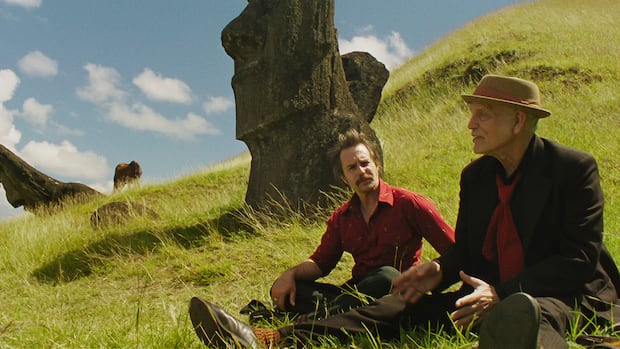
Chesterfield emerges as a perpetually disheartened reflection of Ryan Gosling and Russell Crowe’s characters from The Nice Guys, begrudgingly transporting Carlisle across the remnants of his life. He guides him through fields of indifferent Moai (the indigenous term for Easter Island’s monumental heads—a fact that nearly provokes Carlisle to violence against a group of tourists who explain it to him). He also hastily navigates Carlisle through increasingly disastrous interactions with puzzled locals.
Carlisle, who is also grappling with a memory loss akin to dementia, cannot refrain from discussing the democratically elected leaders he has eliminated in Africa or the Democratic presidents he has dispatched from grassy knolls in Texas.
While this setup hints at a kind of spirited comedy, it does so under the assumption that humor can be found in recognizing the overwhelming futility and indifferent cruelty of existence.
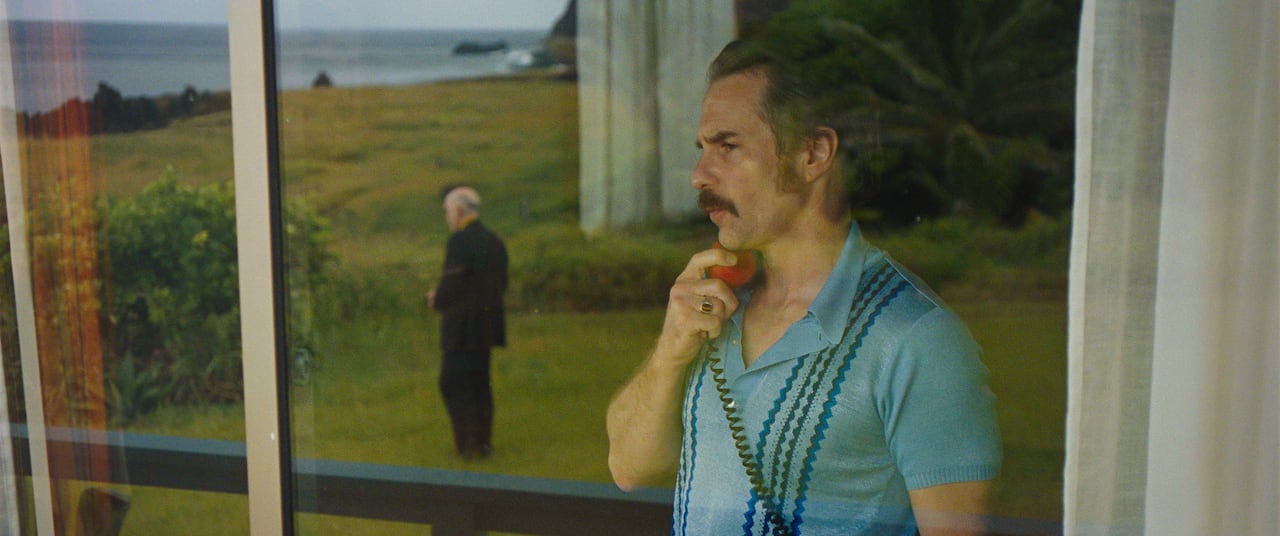
Malkovich, left, portrays the terminally ill CIA operative Chris Carlisle, while Rockwell plays his frazzled friend and partner Lee Chesterfield. (Searchlight Pictures)
This technique has already been utilized by British-Irish writer/director Martin McDonagh in his other darkly humorous works, including Three Billboards Outside Ebbing, Missouri, The Banshees of Inisherin, and the classic In Bruges.
A basic awareness of those widely cherished black comedies should indicate what audiences can expect here.
Moreover, Wild Horse Nine isn’t entirely novel in its adherence to the thematic tone of those films. It recycles the concept of two killers on an eccentric getaway, reminiscent of In Bruges. It borrows the personal tragedy explored for a sense of defeatist, absurd grief from Three Billboards. It shakes in the odd-couple love narrative from Banshees. Voilà: the formula for the charming — albeit somewhat directionless — nature of Wild Horse Nine is established.
Resonating with a somber theme in Hollywood
As an espionage story, there’s little suspense: We are aware of who will perish and roughly when. Think less Jason Bourne, and more JFK.
However, one significant distinction exists. As Carlisle mourns both his vitality (“She’s life and I’m leaving it,” he tells Chesterfield regarding why a woman’s kindness unsettles him) and the individuals whose freedom he has dismantled throughout his life, Wild Horse Nine ultimately proves to be far more disheartening than a presidential assassination.
-
Director Alex Gibney on terrifying Musk documentary: ‘It’s not a funeral; it’s a warning’
-
REVIEW
Tom Cruise is fantastic in Digger. You might hate it
This is a recurring theme that seems impossible to escape while viewing any of Hollywood’s offerings this year. From January’s grim tone-setter 28 Years Later: The Bone Temple, to Spider-Man: Brand New Day continuing Marvel’s fresh fixation on nihilism.
There was the fictional climate-apocalypse comedy Digger, or the four-hour Musk documentary that “humorously” concludes with the destruction of the entire planet. And on the horizon looms Luca Guadagnino’s Artificial: a biopic on OpenAI’s Sam Altman that portrays AI obliterating all human endeavors and meaning, which was submitted to the Golden Globes as a comedy.
With everything appearing so grim in reality, who is actually urging filmmakers to mirror this back to us in our escapism? If the unexpected success of Wild Horse Nine as both a comedy and an extended eulogy holds any truth, it may be because there’s a certain solace in that. Perhaps when confronted with a metaphorical (or literal) gun barrel, the greatest sense of control comes from smiling back at it.
Or perhaps it’s simply that misery enjoys the company.