
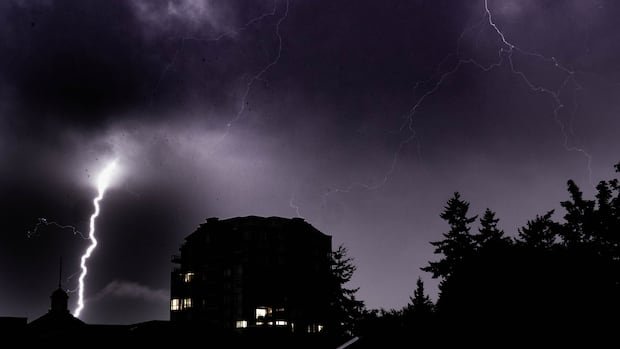


Lightning illuminated the skies over British Columbia’s South Coast during a severe thunderstorm, causing disruptions at Vancouver International Airport and leading to flight delays. Meteorologist Johanna Wagstaffe mentioned the intensity of the storm with hundreds of cloud-to-ground lightning strikes concentrated mainly in Vancouver and Richmond. The low-pressure system, rich in moisture, made landfall near Richmond after its journey from the equator.
Environment Canada reported over 1,800 lightning strikes in the Lower Mainland, while the B.C. Wildfire Service recorded more than 7,000 strikes across the province. The storm resulted in numerous power outages, affecting over 3,800 customers in the Lower Mainland and Sunshine Coast regions.
At Vancouver International Airport, the thunderstorm caused significant delays and cancellations from Saturday night to early Sunday morning. Passengers like Simone McCallum were left stranded at the airport with limited facilities. YVR spokesperson Stephen Smart apologized for the inconvenience and mentioned that the storm brought prolonged lightning and heavy rainfall, disrupting operations for over five hours.
The B.C. Wildfire Service reported about 2,000 lightning strikes in the Coastal Fire Centre and 5,000 in the B.C. Interior, leading to multiple wildfires. Despite the rainfall aiding firefighting efforts, the risk of new fires from smoldering fuel remains due to months of drought conditions.
Environment Canada issued severe thunderstorm watches for southeast B.C., triggering high streamflow advisories in various regions. The storm brought significant rainfall across southern B.C., with notable amounts reported in different areas. Authorities issued travel advisories due to heavy rains, warning of possible road closures on Highway 99.
Overall, the thunderstorm event had a widespread impact on transportation, aviation, and wildfire management across British Columbia’s South Coast and interior regions.