
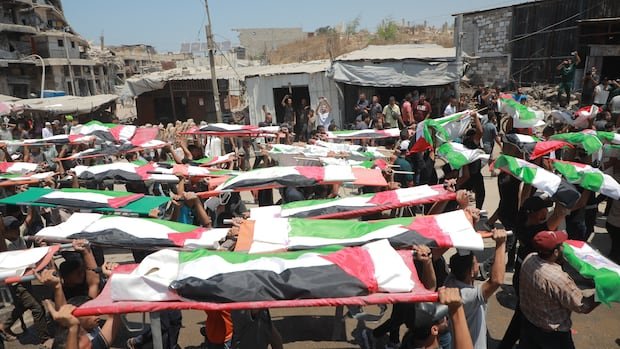


In Gaza City, amidst the debris and remnants of structures, over 100 orange stretchers adorned with Palestinian flags were laid out on Tuesday morning, marking the location of an Israeli airstrike that occurred at the beginning of the conflict.
Among the flags were smaller ones, signifying the bodies of children. Some stretchers had photos placed on them, while others were decorated with flower petals. These remains, now reduced to bones, teeth, and shreds of clothing, belonged to 112 individuals from the Abu Sharia and Hasayna families of the same lineage, who perished in the Israeli attack on their neighborhood on November 23, 2023.
A somber gathering took place on Tuesday as hundreds of people, including surviving family members, congregated to offer prayers for the deceased during their burial at the nearby Baptist cemetery.
The families have been searching for their loved ones for years alongside Gaza’s Civil Defence, a team of first responders tasked with locating survivors and recovering remains at strike sites. However, the retrieval process has been hindered by the lack of heavy machinery in the region.
Mahmoud Hasayneh, present to lay his brothers to rest, expressed the reopening of old wounds for the family, stating, “Now we will start a new broken heart with this mission, and all our family is crying.”
Youssef Abu Sharia, who lost multiple family members in the airstrike, has been tirelessly searching for their remains. Due to damaged heavy machinery in Gaza and Israeli restrictions on importing such equipment, the process has been slow and challenging.
Abu Sharia and some relatives decided to separate when the war broke out to minimize the risk of the entire family being wiped out in one assault. Tragically, his parents and brother, who stayed in Gaza City, were among those killed in the strike.
The funeral on Tuesday brought a mix of emotions for Abu Sharia, a blend of relief at finally laying their loved ones to rest after years of waiting and sorrow over the resurfacing of painful memories.
The families have taken matters into their own hands, physically digging through the rubble in search of their missing relatives due to the lack of proper equipment. Calls have been made by the Civil Defence and human rights groups for Israel to allow heavy machinery into Gaza to aid in the excavation efforts.
Zaher al-Waheidi, head of the health ministry’s records department, revealed that thousands of individuals remain trapped under the rubble in Gaza, with the true number likely much higher due to families being wiped out in single attacks, leaving no one to report the missing.
At the funeral, Mahmoud Basal, the Civil Defence spokesperson, highlighted the urgent need for resources and equipment to facilitate the recovery process, emphasizing the unprecedented scale of the burial for 112 individuals.
The ceremony began with a prayer at the strike site before the shrouded remains were carried in a solemn procession to the cemetery, accompanied by chants and prayers as the families bid their final farewells.
As the Abu Sharia and Hasayneh families mourned their loved ones, thoughts lingered on the thousands still missing, prompting questions of their whereabouts and fate.