
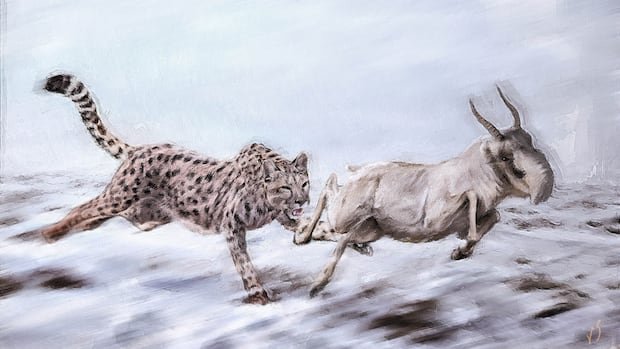


Bones initially thought to be from an ice-age puma or cougar in the Bluefish Caves and a mine site in northern Yukon were actually identified through DNA analysis from the University of California as belonging to cheetahs. The testing was conducted by Molly Cassatt-Johnstone, a lab technician who had just completed her undergraduate studies and was working on some of her first samples at the time.
Yukon paleontologist Grant Zazula recalled his surprise upon receiving the message that the supposed cougars were, in fact, cheetahs. Zazula noted the significant advancements in genetic analysis over the past two decades, shifting from a concept akin to science fiction to a routine practice for studying permafrost-preserved bones from the Yukon.
Cassatt-Johnstone’s discovery of the Yukon Miracinonyx, the extinct American cheetah, made her the first to recognize this species. She is now the lead author of a paper published in Current Biology that provides fresh insights into the ice-age cat’s diet and habitat.
‘Unraveling a Mystery’
Previously, researchers believed the American cheetah, resembling today’s cheetahs with their long limbs and slender bodies, evolved to pursue pronghorns across grassy plains. However, finding them in the Arctic tundra puzzled paleontologists, as there were no pronghorns in Beringia, the ancient land connecting Asia and North America.
To understand how Miracinonyx thrived in this region, the study team, including researchers from Canada and the U.S., employed stable isotope analysis. This technique, also used in forensics, examines chemical clues to determine the diet and environmental conditions of ancient organisms.
Analyzing bone fragments from the cheetah’s limbs, the researchers, led by Matthew Wooller from the Alaska Stable Isotope Facility, uncovered that Yukon cheetahs predominantly consumed fish, a behavior uncommon among historical and contemporary felines.
Paleontologist Julie Meachen, specializing in Late Pleistocene mammalian carnivores, expressed astonishment at this revelation, emphasizing the unique dietary behavior observed in the Yukon compared to midcontinental North America.
The study not only confirmed that Miracinonyx was genetically closer to North American pumas but also revealed low genetic diversity in the population, potentially contributing to their extinction.
Zazula proposed renaming this distinct northern population from ‘American Cheetah’ to ‘Yukon Cheetah,’ highlighting the significance of ongoing discoveries in paleontology.