
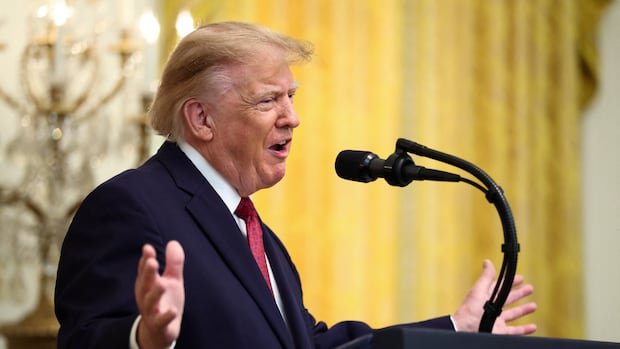


U.S. President Donald Trump escalated his ongoing dispute with Canada during a speech at an event celebrating Hispanic Heritage Month, deviating from his prepared remarks to criticize Canadian leadership as “very bad.” Trump pointed out that previous U.S. leaders allowed automakers to relocate production facilities overseas, including to Canada, which he described as detrimental to American interests.
Despite Canada’s long history of auto manufacturing dating back to 1904, Trump asserted that past administrations enabled other countries to produce cars for the U.S. market. He emphasized his administration’s implementation of high tariffs to rectify this situation and strengthen the U.S. auto industry, indicating a desire to diminish Canada’s manufacturing sector.
Trump accused Canada of exploiting the U.S. for many years and characterized its leaders as taking advantage of past U.S. administrations. He conveyed a message of holding Canada accountable for their actions and teaching them a lesson through various measures, such as renaming geographical landmarks in the U.S.
The President’s remarks followed the recent imposition of an import ban on a range of Canadian products, including alcohol, dairy, and motorcycles. The ban, affecting goods valued at approximately $1.2 billion in Canadian exports, was explained by U.S. Trade Representative Jamieson Greer as a response to Canadian trade practices that disadvantage American businesses.
Additionally, Trump’s trade adviser, Peter Navarro, criticized Canadian leaders for their perceived arrogance and alleged interference in U.S. affairs. Navarro accused Canadian lobbyists of influencing elected officials and highlighted longstanding trade imbalances between the two countries.
In response to the escalating tensions, Canadian Prime Minister Mark Carney expressed a willingness to negotiate a mutually beneficial trade agreement with the U.S., emphasizing Canada’s readiness for constructive dialogue. Meanwhile, U.S. officials reiterated openness to potential trade deals but indicated satisfaction with the current trade relationship dynamics.
Contrary to the Trump administration’s assertions of unfair trade practices by Canada, data indicates a more nuanced picture of the trade relationship. Despite complaints about tariffs, the U.S. benefits from a trade surplus in services with Canada and significant agricultural trade ties. Most U.S. agricultural products enter Canada duty-free, with specific tariffs applying only under certain conditions, as outlined by trade agreements and industry sources.