
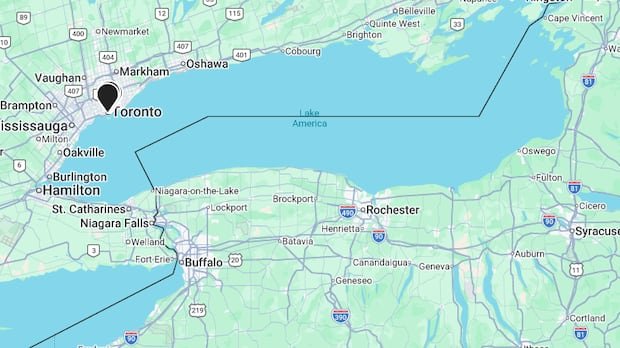


Several Canadian websites, including those of the federal government, presented maps with Lake Ontario renamed as Lake America on Sunday following Google Maps’ adjustment to comply with a directive from U.S. President Donald Trump.
Google stated in a post on its website on Saturday that the alteration was made as the U.S. government’s official geographic names database had officially rechristened the lake.
Although Google mentioned that the change would impact only American users, various Ontario and Canadian websites displayed Lake America on their maps.
Among these were Hydro One’s outage map, the Liquor Control Board of Ontario (LCBO) store locator, GO Transit’s station finder, and the federal government’s housing and infrastructure map.
Responding to the situation, a spokesperson informed CBC News via email that Hydro One acknowledged the “error” in incorrectly labeling Lake Ontario on its outage map, attributing it to a third-party mapping service.

A screenshot from the Liquor Control Board of Ontario’s website on Sunday depicts Lake Ontario labeled as Lake America, which has since been corrected back to Lake Ontario. (CBC)
Hydro One stated, “We are collaborating with our vendor to quickly rectify the issue and restore the accurate geographic reference.”
Metrolinx, a provincial agency that oversees GO Transit, acknowledged the issue and mentioned that corrective action was being taken.
Metrolinx stated, “We are actively verifying all our websites to ensure the correct naming of Lake Ontario as Lake Ontario. We are also in the process of deactivating the map function on the GO stations’ page where the error occurred.”
By the late afternoon on Sunday, the problematic GO Transit map had been deactivated, and the LCBO map had been rectified to display Lake Ontario once more.
Contrary to Google’s decision, MapQuest, a U.S.-based online mapping service, announced that it would retain the name Lake Ontario, while Apple has not publicly addressed the issue.
In a statement Sunday night, Google clarified that website developers incorporating Google Maps could localize the map by selecting a specific region to determine the display of place names.
According to the statement, “‘Lake Ontario’ will appear when developers set their region to Canada.”
<h2 class="h2-WTv89 html