
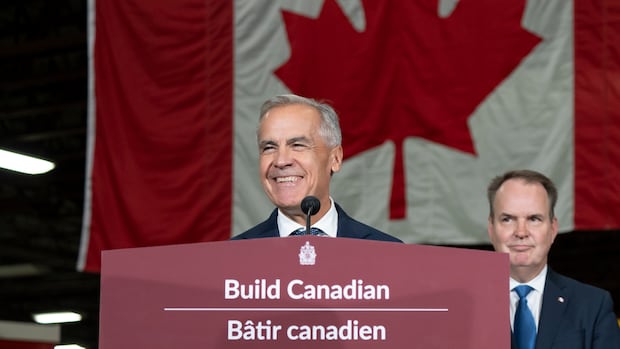


Prime Minister Mark Carney has rejected a recent wave of statements from U.S. cabinet officials that question the Liberal government’s rationale for its withdrawal from trade negotiations last month.
“With all due respect, I don’t believe that appointed, unelected cabinet members in the United States are authorities on Canadian political matters,” he stated in Thunder Bay, Ontario, on Thursday.
Following Canada’s decision to pull its negotiating team back to Ottawa on Friday, August 21, Carney and Canada’s chief trade negotiator Janice Charette have consistently argued that the country withdrew due to last-minute U.S. changes that were viewed as unfair and economically unsound.
Carney asserted that these alterations would have limited Canada’s capacity to forge trade agreements with other nations, undermined cultural protections for the French language, and gradually weakened the auto sector.
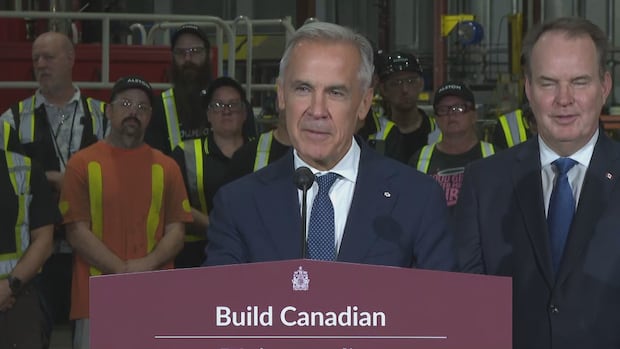
Prime Minister Mark Carney addressed U.S. Commerce Secretary Howard Lutnick’s recent assertion that the breakdown of trade negotiations was due to internal Canadian politics. Carney emphasized collaboration with provinces, international allies, labor, and businesses, stating, ‘We’re not positioning on this stuff.’
“There were certain points that the United States insisted on until the final hour: red lines that were non-negotiable, and it was a take-it-or-leave-it stance. Now they seem to have changed,” Carney remarked.
“Suddenly, they appear indifferent to Canadian language and cultural aspects. If that was the case, they shouldn’t have included those elements in the agreement.”
This contrasts sharply with the narrative being pushed by the Trump administration following the collapse of the trade talks.
Carney emphasizes the need for U.S. recognition of Canada’s red lines
“We had an agreement, we shook hands, and the president made the announcement. There was a positive atmosphere. Canada opted to withdraw for political reasons; this is purely political,” U.S. Commerce Secretary Howard Lutnick stated last week.
“If you think I ever mentioned the word French. Do I care about how the Québécois communicate? It matters little to America; we simply don’t care,” he added. “The fact is we never brought those terms up; this is all fabricated.”
Lutnick claimed that the French language issue was “manufactured” to ensure the Parti Québécois loses the Quebec election and that federalists would prevail in the upcoming Alberta vote regarding an independence referendum.
U.S. Trade Representative Jamieson Greer, who led the negotiations for the Trump administration, also contradicted Ottawa’s claim that last-minute demands from the U.S. derailed the agreement.
In an interview with CBC News chief political correspondent Rosemary Barton, Greer remarked that late in the discussions Canada “had some additional views and requests that were excessive for the U.S.”
-
Exclusive
What went wrong with U.S. trade talks, according to Canada’s chief negotiator
-
Carney says Trump and his cabinet should stop ‘throwing shade’ and get serious about a deal
Carney dismissed these alternate accounts, outlining what he requires to see before Canada re-engages in negotiations with the Trump administration.
“Some of their current statements differ from what they were insisting on during the talks, and we will consistently advocate for what serves Canada’s best interests,” he emphasized.
The prime minister indicated that to resume discussions with the U.S., he seeks a deal that is sustainable over time and advantageous for both nations.
“We are prepared to negotiate that agreement when the Americans are ready,” he stated.
Carney added that this would occur when the U.S. acknowledges and respects Canada’s red lines.
“Our stance is unequivocal. We need to safeguard and promote the French language, Canadian culture, and Quebec culture. This is fundamental,” he stated. “We must retain our sovereignty to forge trade agreements with other nations.”
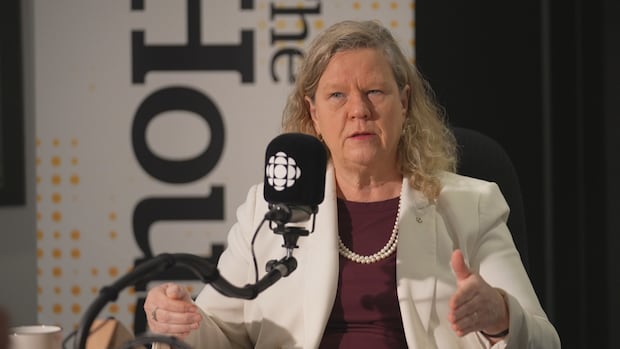
In a conversation with CBC’s Catherine Cullen on Friday, Canada’s chief trade negotiator Janice Charette responded to U.S. Commerce Secretary Howard Lutnick’s assertion that Canada had only recently raised concerns about medium- and heavy-duty trucks. Charette clarified that while it is true that these concerns were mentioned on the last Friday of negotiations, they had also been brought up earlier, on Monday, Tuesday, Wednesday, and Thursday.
Carney stated that Canada must be assured of the agreement’s durability and that any reduced or eliminated tariffs would not be reinstated unexpectedly in the future.
“There were several instances during the negotiations where those safeguards were not going to be provided, and in fact, the opposite was going to be inserted, which is unacceptable,” he noted.
Following Carney’s remarks, U.S. President Donald Trump took to Truth Social to accuse Canada’s prime minister of framing the president as the antagonist for political gain.
“It’s politically beneficial for Canadian politicians like Prime Minister Carney to depict President Donald J. Trump as ‘the enemy,’ until their economy fails, at which point it will be politically damaging — worse than anything that has ever happened to a Canadian politician,” Trump wrote.
Acknowledging the integrated auto sector
Carney acknowledged that Canada would not be able to secure a trade agreement resembling those the two nations might have signed prior to the U.S. altering its tariffs and commercial policies, but the deal still needs to be favorable for Canada.
“It’s not about reverting to past agreements. However, the conditions regarding our automotive sector, steel industry, and aluminum sector must remain competitive,” he highlighted.
-
Republicans back Trump in his trade war with Canada
-
Canada ready to further distance itself from U.S. on military procurement
To achieve this, Carney mentioned that the U.S. administration must also acknowledge that the auto industry operates as an integrated sector across the border.
Since the breakdown of those trade discussions, Trump and his administration have resorted to mocking Canada on social media and teasing Canadians by renaming Lake Ontario “Lake America.”
U.S. Treasury Secretary Scott Bessent likened Canada’s navy to a now-defunct amusement ride at the West Edmonton Mall, while U.S. Transport Secretary Sean Duffy remarked that Canada is “a country lacking a military.”
On Tuesday, Carney dismissed such insults, stating that the conduct of senior U.S. officials engaging in behavior of that nature is “beneath their office.”