
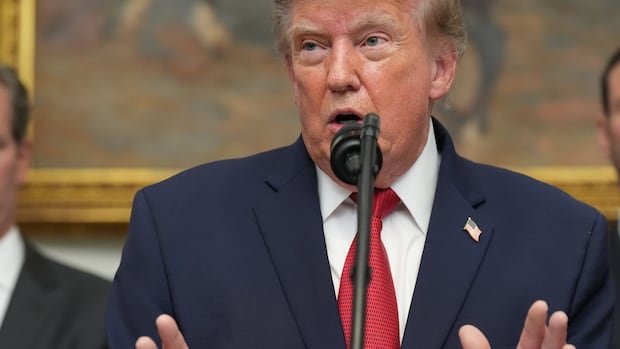


President Donald Trump declared on social media Wednesday his intention to initiate what he described as “the MOST CRUSHING ECONOMIC OPERATION EVER TAKEN AGAINST ANY COUNTRY” against Iran. Characterizing the action as Economic Warfare and Isolation on an unparalleled level, he shared scant specifics on Truth Social.
He cautioned about economic repercussions for any nation that backed Tehran or extended support to Iran in any form. “ANY country that permits its financial institutions, businesses, airports, or government entities to offer any form of support to Iran will face SIGNIFICANT Economic Consequences,” Trump emphasized in a social media post.
Although he did not outline the precise measures Washington would adopt against such a nation, nor did he name any specific country, he underscored the urgency, stating, “Oil smuggling, swap lines, cash transfers, exchange houses, ship registries, front companies — It all needs to stop NOW. You know who you are.”
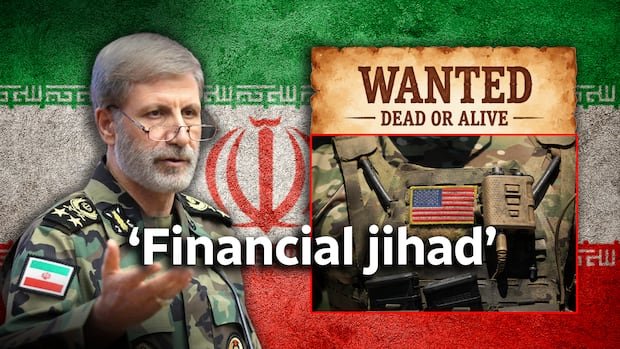
Iran is offering a $30,000 US bounty to any Iranian who can capture or kill American soldiers. Andrew Chang breaks down why the timing of the announcement matters, its propaganda value, and how realistic it actually is.
(Photo credits: The Canadian Press, Reuters, Adobe Stock and Getty Images)
The ongoing six-month war has resulted in numerous casualties, drawing involvement from countries across the Gulf region. Simultaneously, global markets have been unsettled by Iran’s capability to regulate shipping through the Strait of Hormuz, a crucial passage for about a fifth of the world’s oil trade before February.
Despite two ceasefire agreements announced by the U.S. and Iran in April and June to restore the smooth flow of shipping through Hormuz to pre-war levels and potentially end the conflict, both agreements quickly collapsed. This occurred even as Israel largely disengaged from the combat it initiated alongside the U.S. in February.
Trump’s social media pronouncements and threats are not consistently followed through as stated.
Conflicting accounts of U.S.-Iran talks
The United Arab Emirates, hosting a significant U.S. military base, disclosed on Tuesday the suspension of all trade activities, commercial exchanges, and financial transactions with Iran until further notice.
This announcement followed claims by the UAE defense ministry of detecting two missiles launched from Iran that landed in the sea, a report Iran rejected as unfounded.
China, which purchases over 80% of Iran’s exported oil according to 2025 data from analytics firm Kpler, poses a risk for the U.S. to engage in escalated economic actions against China — a prominent U.S. exporter, including of critical rare-earth minerals — potentially inviting retaliatory measures.
Mohammad Mokhber, an advisor to Iran’s supreme leader, affirmed on Tuesday that Iran remains open to discussions with the U.S. while