
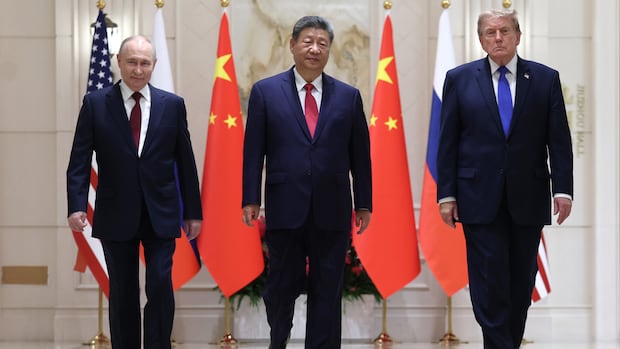


Prior to Vladimir Putin’s meeting with Xi Jinping and Donald Trump at a luxury resort near Shenzhen, China, a Kremlin aide informed a journalist that the Russian leader was in high spirits.
Although Ukraine had reportedly targeted Russia’s significant Kerch Bridge to Crimea for the third time that week just hours before, Putin appeared to be in a celebratory mood due to the well-rehearsed proceedings at the APEC summit.
Before engaging in a private discussion with Trump, the U.S. president warmly welcomed Putin, referring to him as “my friend.”
At the conclusion of the key event—a 90-minute trilateral discussion—the leaders released a four-point “Declaration towards Peace” that not only reflected Putin’s interests but also challenged global organizations like the United Nations and the International Criminal Court (ICC).
The joint statement advocated for an increase in the worldwide supply of refined petroleum products, a positive development for Russia’s heavily sanctioned energy sector.
It also cautioned that the ICC “and similar entities must not overstep their authority.”
This sentiment resonates with Putin, especially since the ICC has issued an arrest warrant for him on charges of war crimes in Ukraine.
Jonathan Eyal, associate director of the Royal United Services Institute, noted in a briefing to journalists that “The leaders of China, Russia, and the U.S. appear united in their belief in a stringent interpretation of sovereignty, allowing their nations to act as they please with minimal accountability.”
He added, “This summit was intended to address global issues, yet it culminated in a clear dismissal of globalization.”
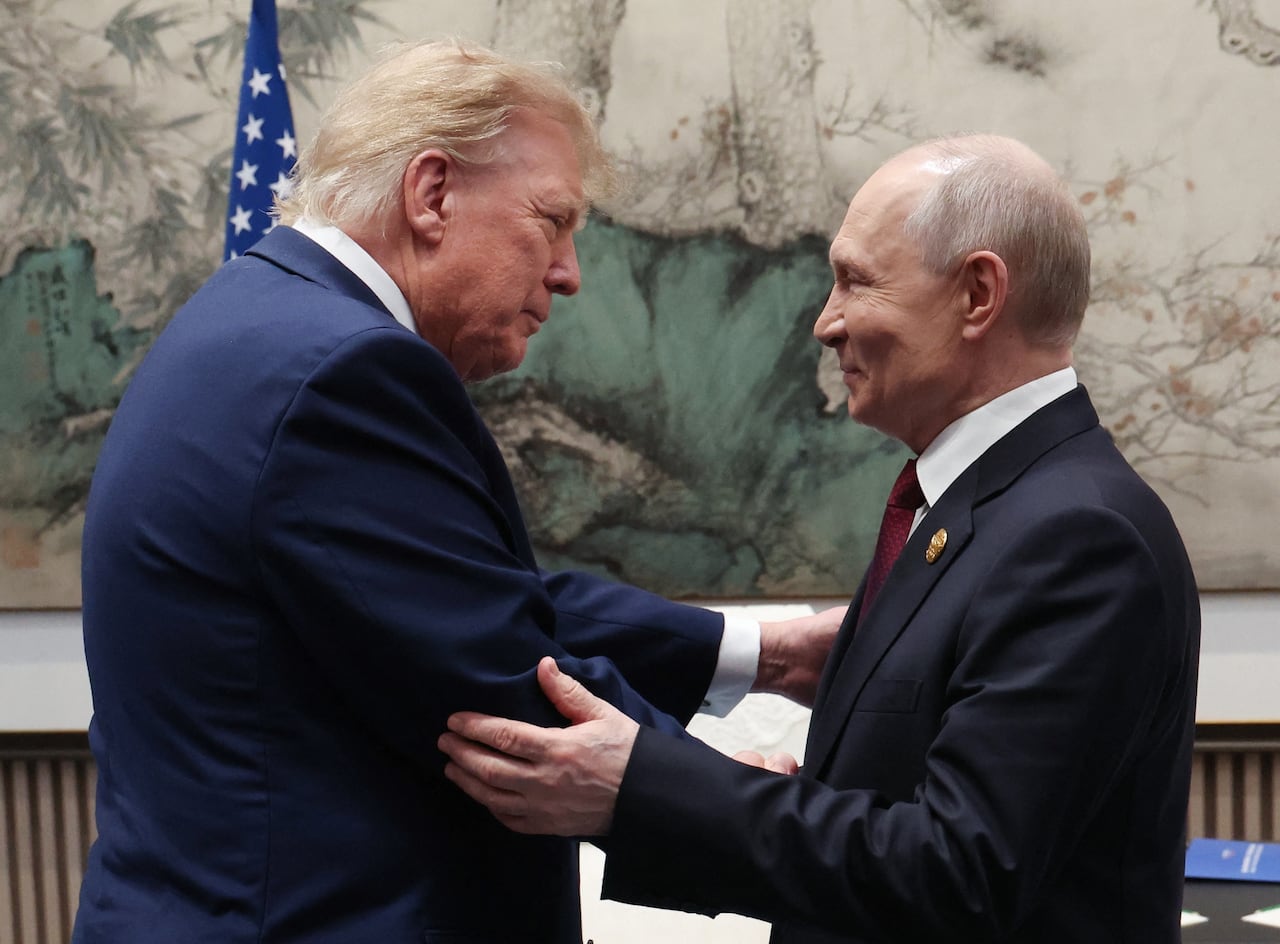
In this image provided by the Russian state agency Sputnik, Putin and Trump shake hands at the APEC summit in Shenzhen, China, on Thursday. (Getty Images)
Big on symbolism, lacking in specifics
The post-meeting statement did not address Ukraine. Following the meeting, Putin faced journalists in Shenzhen and reiterated long-standing points regarding Ukraine, NATO, and his assertion that Kyiv and Europe are impeding peace.
Even though the formal meeting was short, the buildup to it was extensive in terms of publicity and political analysis.
Some analysts speculated that this meeting could evoke memories of the Yalta Conference in 1945, where leaders from the U.S., U.K., and the Soviet Union convened to define their spheres of influence at the close of World War II.
Russian media embraced this comparison. As the trilateral session concluded on Thursday, a reporter from Kommersant, a publication based in Moscow, posed a question to Putin about whether the meeting was akin to a “Yalta 2.0,” to which Putin responded with a nod.
In a notable turn of events, he found himself at the heart of a significant geopolitical discussion alongside major global leaders, despite ongoing Russian strikes on Ukrainian cities.
Responding to a query from BBC News, Putin stressed that the summit was not merely a “photo opportunity.”
“It is serious collaborative work,” he asserted. “The objective is to identify mutually agreeable solutions for the three of us, particularly in the security domain.”
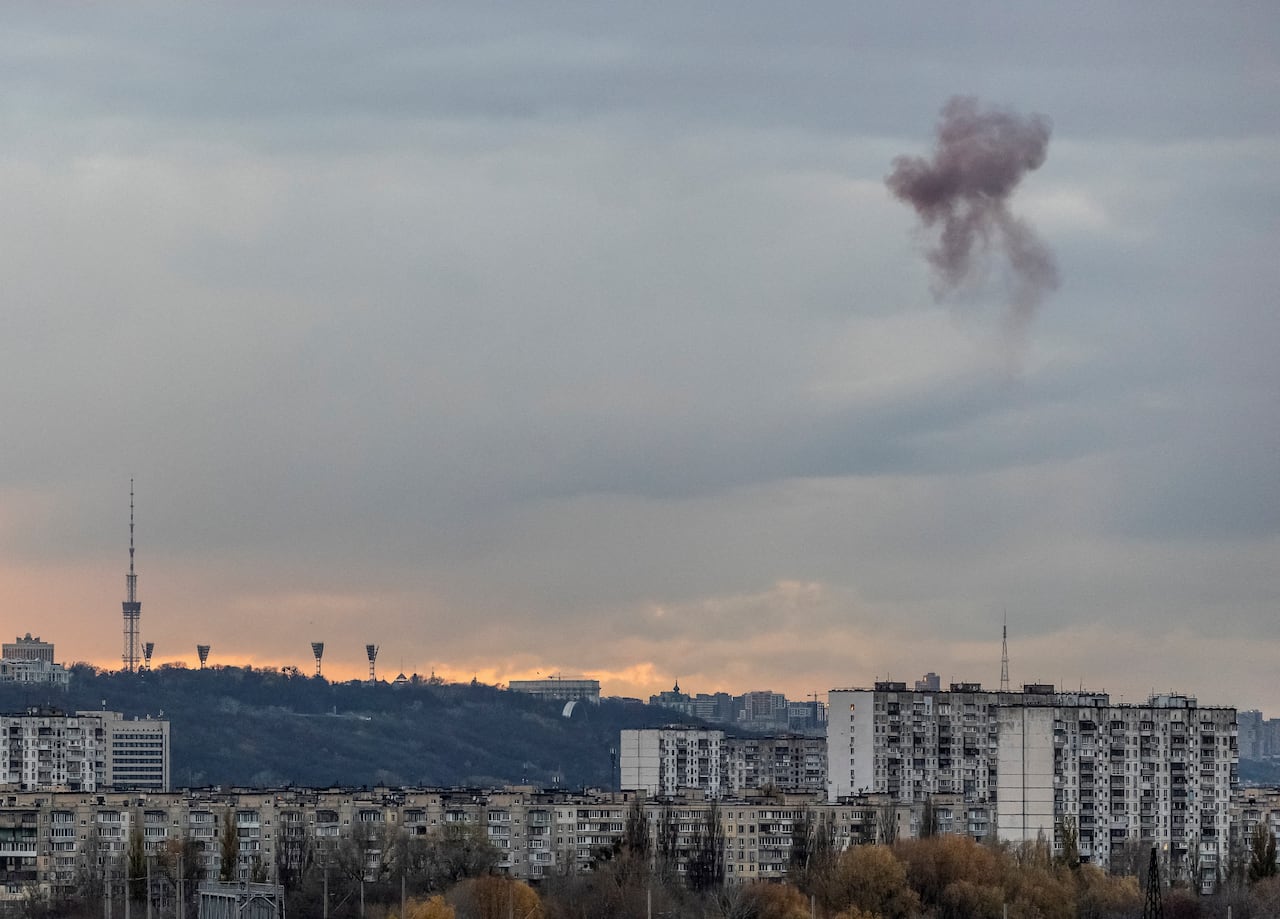
A plume of smoke rises over Kyiv, Ukraine, on Thursday after a local air defense unit intercepted a Russian drone. (Reuters)
Nuclear capabilities
The extent to which the conflict in Ukraine influenced the discussions remains unclear. Chinese President Xi did not specifically mention the conflict during his public remarks, although he did emphasize the necessity for major powers to “safeguard world peace.”
China has maintained a position of neutrality throughout Russia’s full-scale invasion but has bolstered Moscow’s military efforts by providing technology and purchasing its sanctioned oil. Kyiv, along with European nations, has urged Beijing to increase pressure on Russia to help bring the conflict to a close.
China’s state-run Xinhua news agency reported that before the meeting, Xi touched upon nuclear weaponry, characterizing it as a “sword of Damocles hanging over humanity” and advocating for their “complete prohibition.”
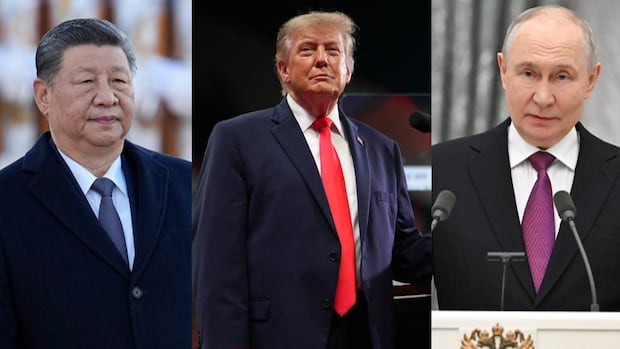
The sit-down marks the first encounter between the three leaders, who are expected to discuss the conflicts in Ukraine and Iran, along with nuclear proliferation. Countries like Canada will be observing closely. Stay updated on CBCNews.ca, the CBC News App, and CBC News Network for breaking news and insights.
China is believed to possess approximately 600 nuclear weapons, while both Russia and the U.S. have over 5,000 each.
While the official statement indicated that all three leaders concurred that a nuclear war “cannot be won and must never occur,” Russia seemed to intentionally underscore its status as the holder of the largest nuclear arsenal.
As Putin arrived in China, state television presenter Yevgeny Popov—who also serves as a lawmaker for the ruling United Russia party—was broadcasting live when a military officer with a briefcase passed by. Popov inquired whether it was the “nuclear briefcase,” which is used to connect Putin to Russia’s nuclear forces.
The officer confirmed this with a smile.
This week, Russia also sent two of its nuclear-capable bombers to Vietnam, causing Japan and South Korea to scramble their fighter jets in response.
Criticism of UN and ICC
Sergey Radchenko, a professor at the Henry A. Kissinger Center for Global Affairs at Johns Hopkins University, expressed to CBC News that he found the statement regarding preventing nuclear conflict intriguing, as it echoed discussions from summits between U.S. President Ronald Reagan and Soviet General Secretary Mikhail Gorbachev in the 1980s.
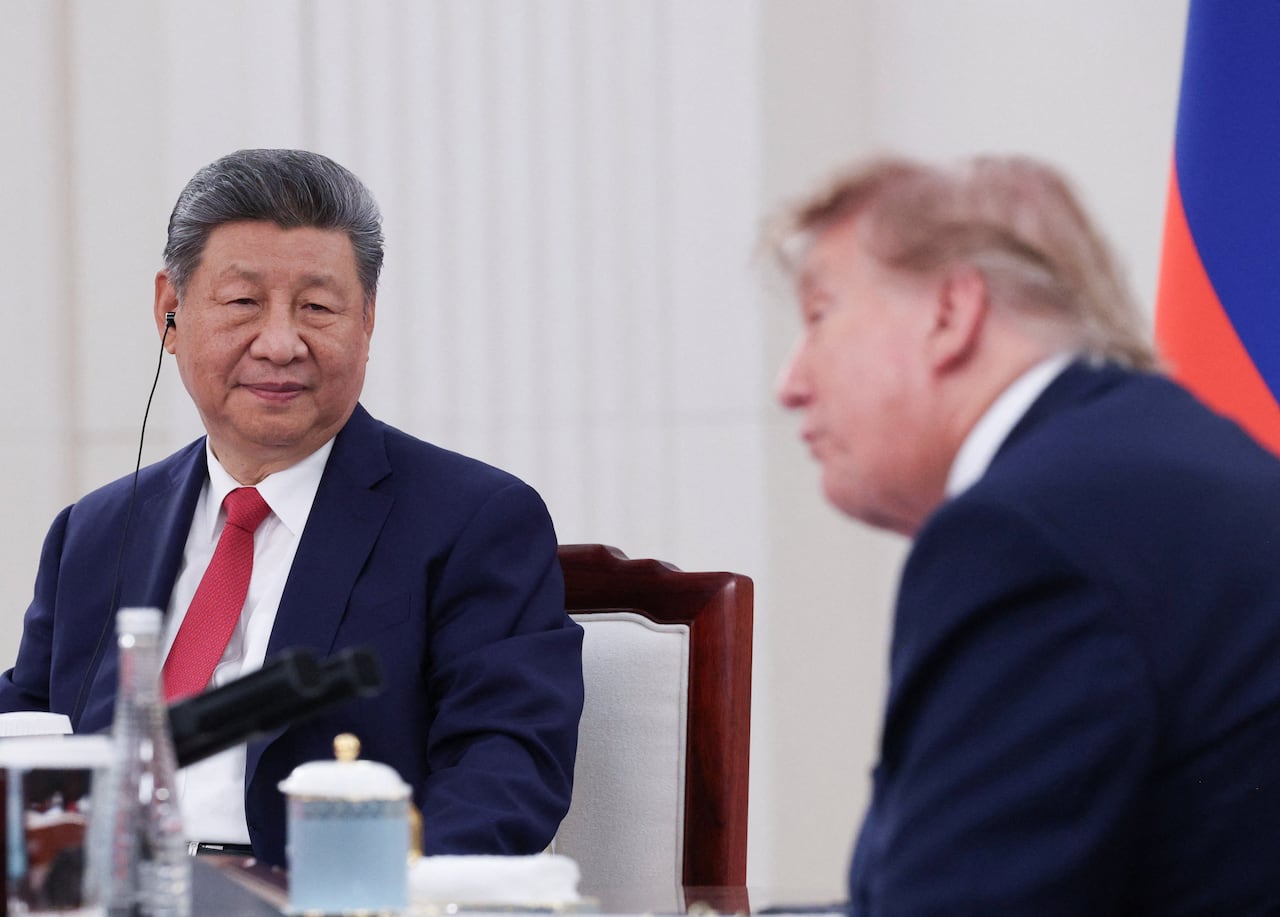
Xi and Trump are depicted meeting on Thursday. (Reuters)
However, Radchenko noted that there was a lack of detailed information overall.
He remarked that it was unsurprising for all three leaders to advocate for a reform of the UN, where they hold permanent seats on the Security Council.
More notably, he pointed out, was their agreement on a statement emphasizing the importance of respecting the “immunities” of state officials.
The Trump administration has previously criticized the International Criminal Court and last year imposed sanctions against it, claiming it was engaging in “unfounded actions targeting America and our close ally Israel.”
“It’s evident that Putin would oppose the International Criminal Court. However, it’s intriguing to see Trump also align with this position,” Radchenko commented.
“This reflects his general attitude and mindset. He clearly believes he should be above the law, just as Putin and Xi should be.”