
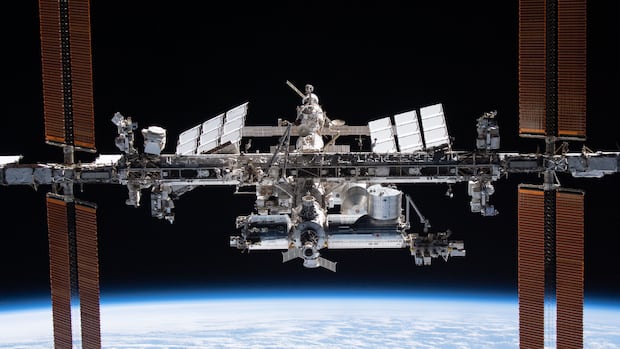


In the upcoming weeks, provided the skies are clear, viewers will have the opportunity to see the International Space Station (ISS) glide through the evening sky.
If you’re fortunate enough to spot it, consider waving at Canadian Space Agency astronaut Joshua Kutryk, who is traveling at a speed of 7.66 kilometers per second.
Kutryk is part of a seven-member team currently residing and conducting research aboard the ISS as part of Expedition 75.
Since his arrival on the ISS on October 1, Kutryk has been engaged in numerous experiments and responsibilities, including a recent cardiac research.
Naturally, he has also been taking in the stunning views.
The ISS is frequently observable from Canada as it orbits the planet. However, in the coming weeks, it will be visible during evening hours, in contrast to its recent early-morning appearances.
How to locate the ISS in the night sky
Essentially, it will appear as a very bright white point — noticeably brighter than the many fainter satellite lights you may observe moving across the sky. Unlike airplanes, it won’t have any flashing lights and will move consistently in one direction.
-
Joshua Kutryk says he’s ‘having a blast’ on the International Space Station
-
Canadian astronaut Joshua Kutryk conducts his 1st spacewalk
To find out when the ISS will be passing overhead, there are several methods you can use.
One option is to visit heavens-above.com, a website that provides tracking for various satellites and spacecraft. By registering your location, you can find the ISS among other visible objects, and it will generate a schedule of times similar to the example below.
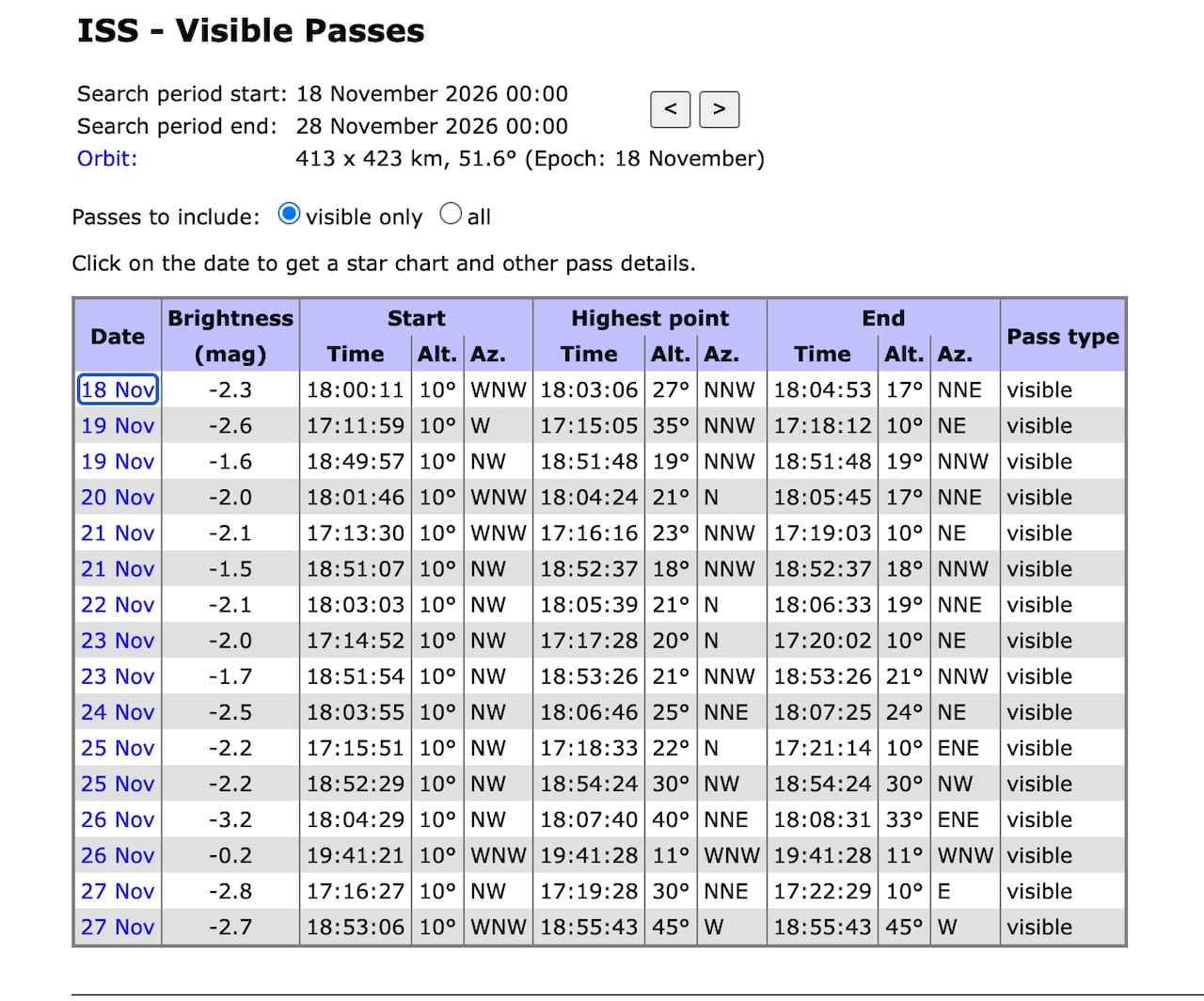
This chart shows the times the ISS will be visible over Toronto over the next couple of weeks. (Heavens-above.com)
Regarding brightness, a more negative number indicates a brighter appearance (it might seem counterintuitive, but that’s how astronomy works).
Clicking on a date will reveal a sky map showing a line that crosses various constellations, illustrating the path of the ISS.
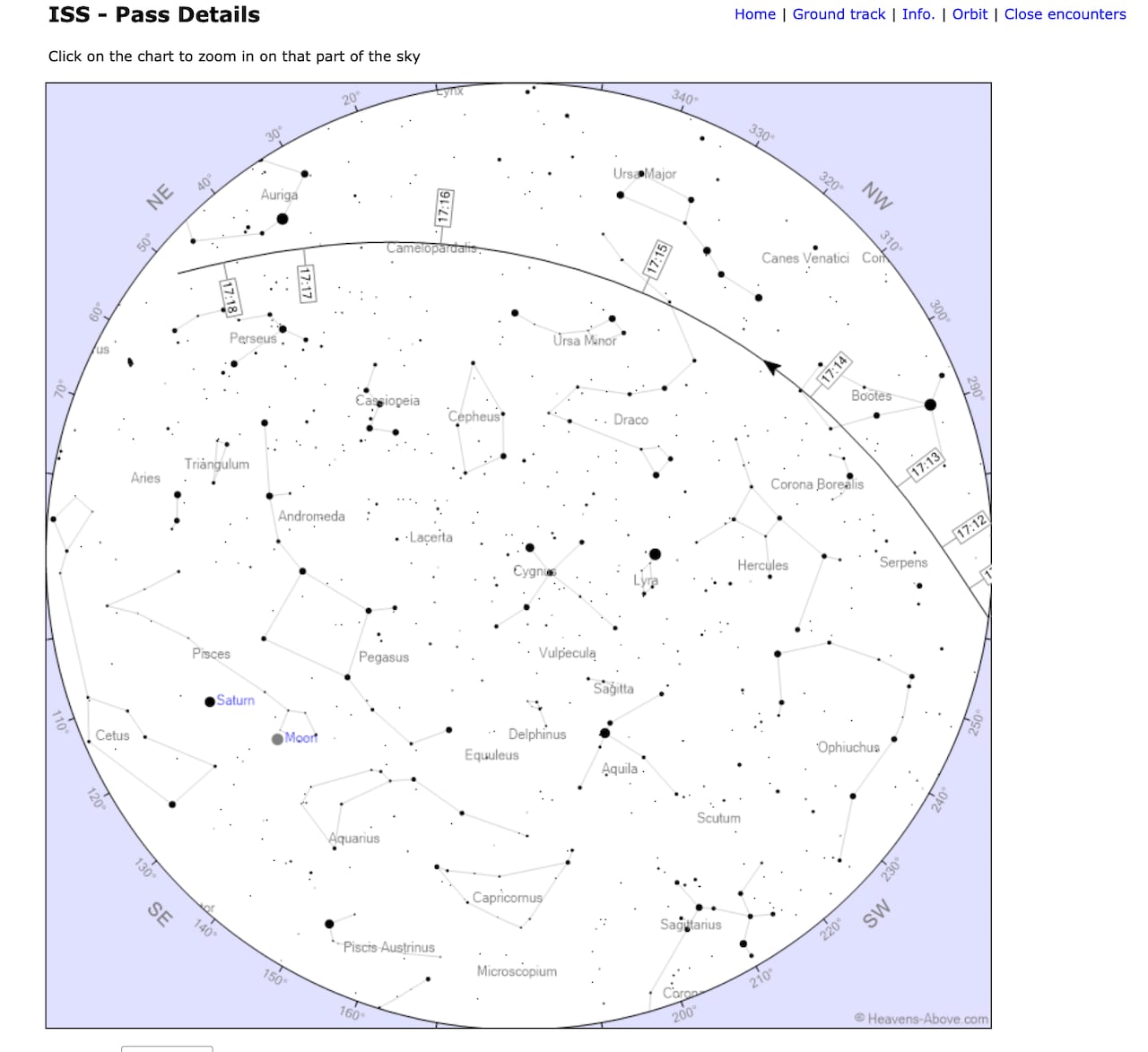
This map of the night sky shows the constellations and the path the ISS will take on this particular pass. (Heavens-above.com)
If the map shows only a short line near the horizon, it may be best to skip that date, as the ISS could be more difficult to spot.
Conversely, if it indicates a longer line, it might be worth a try, provided you have a clear view.
The constellation map will also indicate local times when the ISS will be visible, which is incredibly useful.
NASA’s Spot the Station app is another excellent tool.
Upon launching the app, it should automatically pinpoint your location. The home screen will display a countdown to the next ISS pass. The “Sightings” section will show a list of imminent passes.
Additionally, it features an AR View (augmented reality) that provides details about the sky when you point your phone at it, including a line indicating the ISS’s trajectory.
If you manage to see the ISS as it traverses the sky, just imagine that Joshua Kutryk might be glancing back at you.