
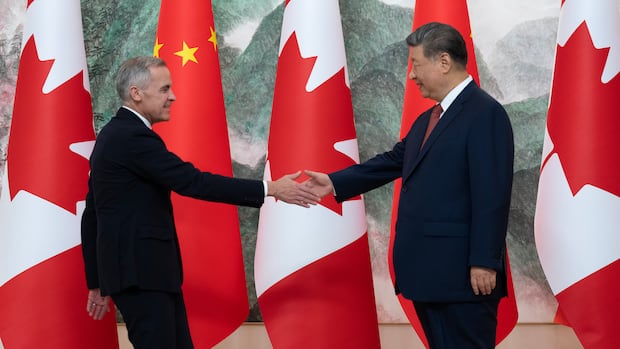


Prime Minister Mark Carney has successfully negotiated a new trade agreement with China that aims to provide substantial relief to Canadian industries that have long faced burdens from tariffs and bureaucratic hurdles.
However, the Canadian government is also making its own compromises, leading to discomfort among some critics wary of China.
Amid the Meng Wanzhou incident — where the Huawei executive was detained at the request of the U.S. on fraud allegations — China has held Canadian citizens. The 2024 inquiry into foreign interference has highlighted China as “the most prominent actor of foreign meddling” in Canada.
Last year, during a debate among leaders, Carney labeled China as the “greatest security threat” to Canada. His administration established a new registry for foreign influence to combat interference from China and other nations.
However, with relations with the U.S. strained as the Trump administration imposes severe tariffs on Canadian goods, Carney has adopted what he calls a more “pragmatic” and “constructive” stance towards China while ensuring “guardrails” are in place to limit excessive entanglement.
Following a meeting with Chinese President Xi Jinping on Tuesday, the Prime Minister’s Office reported that Carney agreed to “further enhance this partnership” with China.
According to the PMO, “The leaders concurred that the citizens of both nations are benefitting from these renewed connections between Canada and China.”
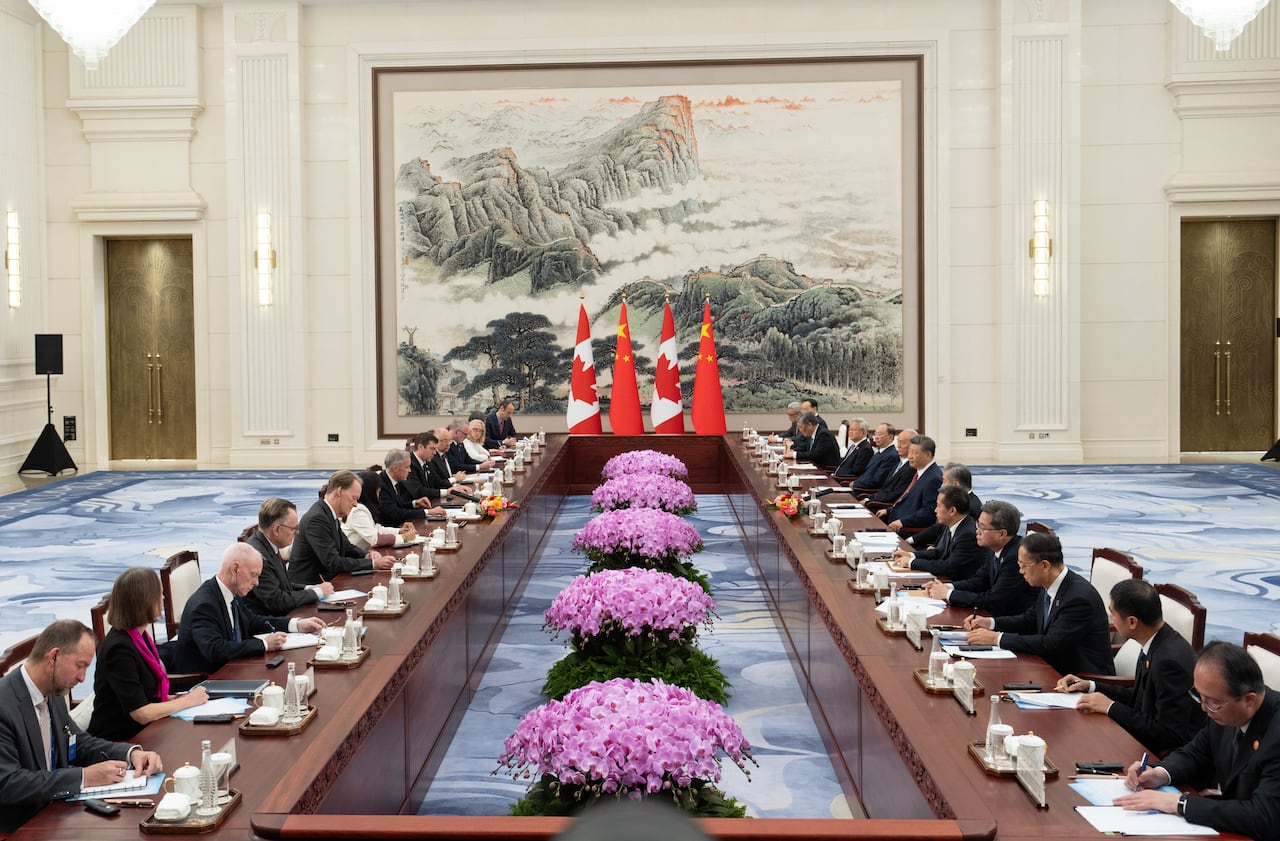
The meeting between Carney and Xi occurred during the APEC summit in Shenzhen, China. (Adrian Wyld/The Canadian Press)
Michael Kovrig, a former diplomat and one of the two Canadians detained in China after Meng’s arrest, expressed his concern over the warming relations, advising Carney to proceed with caution.
In a conversation with CBC News, Kovrig acknowledged that ties with China have improved but stated, “they’re still not back to normal and should not be.”
“There are definitely potential advantages. The challenge lies in ensuring that these benefits do not come with larger and more troublesome drawbacks,” he remarked.
Kovrig pointed out that China has previously used tariffs as a means to retaliate against Canadian farmers and could do so again.
“The summary does not mention anything regarding national security, transnational repression, human rights concerns, or Canadian detainees in China. These issues should also be prioritized alongside market access,” he emphasized.
Kovrig cautioned that building closer ties with China, including permitting new imports such as electric vehicles and steel products, could provoke anger from the United States, jeopardizing what he considers Canada’s most vital economic relationship.
“Washington has to come first. I understand that this may not be a popular sentiment in Canada right now,” he stated.
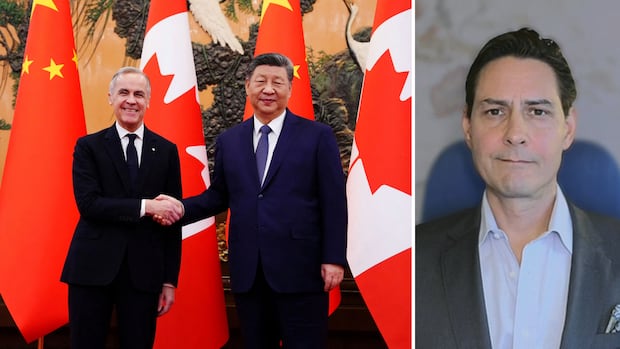
Michael Kovrig, a former diplomat who spent over 1,000 days in captivity in China on espionage allegations, asserts that while the trade relationship between Canada and China is significant, it must be managed with caution, as the benefits of Prime Minister Mark Carney’s new deal appear lopsided in favor of China.
Trump himself has negotiated trade agreements with China, lauding Xi as a “great leader,” while his administration faces challenges stemming from the past interactions of the former Nvidia CEO with an alleged Chinese spy.
Trump’s commerce secretary, Howard Lutnick, has also been criticized for attempting to relax U.S. chip export regulations to benefit Asian AI data centres that engage with China.
Amidst these controversies, Peter Navarro, a trade adviser to Trump and a frequent critic of Canada, described Carney’s dealings with China as “extremely offensive.”
“China is going to exploit Canada,” he warned.
Nevertheless, early indicators suggest that overlooking China’s past misdeeds is yielding positive outcomes for Canadian businesses and their workforce.
Xi has committed to lifting “anti-discriminatory tariffs,” which could be as high as 25 percent on certain $400 million worth of Canadian pork and seafood products — a move that will provide immediate advantages to those sectors by granting access to China’s expansive food market.
Alongside a pledge to increase purchases of lentils, fava beans, “wild aquatic products,” and pet food, Xi is continuing the tariff suspension that Carney negotiated in January for Canadian canola meal, peas, lobster, and crab, which has been beneficial for the economy.
Indeed, following Carney’s initial meeting with Xi, along with what the government claims are 35 additional ministerial visits aimed at resolving bilateral issues, Canadian exports to China have seen a significant increase.
Data from Statistics Canada and the University of Alberta’s China Institute indicate that Canadian trade with China reached an unprecedented $12.7 billion last quarter.
The monetary value of Canadian goods exported to the Asian economic giant has surged by 60 percent over the past two years, a consequence of Carney’s efforts to mend relations with Beijing.
Kyle Larkin, president and CEO of the Canadian Meat Council, stated that pork producers have been adversely affected by the Chinese restrictions, and Carney’s agreement to eliminate many of these obstacles is “a significant move in the right direction.”
“We’re quite pleased,” he conveyed to reporters in China.
Vina Nadjibulla, co-founder and CEO of the Centre for Strategic Statecraft, commented that U.S. trade policies compel Canada to seek alternative business opportunities, even as concerns remain about partnering closely with a nation like China.
“China’s actions remain unchanged, but Canada’s strategic situation has evolved,” Nadjibulla stated in an interview.
“We are now in a landscape where diversifying our economic partnerships is essential, and we must engage with China on certain fronts. However, I hope we remain prudent and strategic without disregarding the lessons learned from history.”
In exchange for increased access, Carney is allowing a broader influx of Chinese steel and aluminum imports by extending and enhancing remission measures for products that are not readily available in sufficient quantities domestically.
There is also a vague assurance to “enhance cooperation” in the area of “finance.”
Additionally, Carney will continue to permit tens of thousands of Chinese electric vehicles to enter Canada annually at a reduced tariff rate — although the actual number imported thus far is significantly lower than this year’s quota of 49,000.
A background document on the Carney-Xi agreement shared with reporters indicates that, after past approvals by BYD, another unnamed Chinese firm has just received the necessary permissions from Transport Canada to import its vehicles from abroad.
A government representative confirmed that Geely, an automotive conglomerate with interests in brands such as Zeekr, Polestar, and Lotus, has now been granted approval.
Much of Canada’s automotive sector has vigorously opposed granting Chinese companies access, concerned that an influx of cheaply produced, state-subsidized vehicles could undermine remaining Canadian automotive and parts manufacturing.
While the Carney administration had anticipated significant manufacturing investments from Chinese electric vehicle manufacturers in Canada, no such developments have emerged — and the background document issued to reporters implies that none are forthcoming in the near future.
Flavio Volpe, president of the Automotive Parts Manufacturers’ Association (APMA), advised CBC News that Ottawa must resist any urges to permit Chinese companies to send “knock-down” car kits to Canada for assembly.
Volpe noted that Chinese companies have assured nations like Brazil that these kits are merely a preliminary step until they can establish local manufacturing capabilities, only to later abandon those commitments.
He expressed that these kits, which contain no Canadian components, could endanger the domestic industry and irritate the U.S., which supplies numerous parts to Canadian assembly facilities.
“Would that jeopardize any potential trade agreement with the Americans? It certainly draws their attention,” he commented regarding the introduction of more Chinese-manufactured vehicles in Canada.
Despite the industry’s concerns, Carney exhibits a willingness to collaborate with these Chinese firms while the relationship with the U.S. remains troubled.
“We have the finest auto workers globally, and we want them fully engaged, with ample opportunities, in an integrated North American market,” Carney told reporters accompanying him on his nine-day trade mission.
“That market has become less integrated due to U.S. trade actions.”