


Canada is currently in discussions to join a significant European exchange initiative that could enhance opportunities for Canadians to study, work, and reside in Europe.
During the Canada-EU summit held last month and as outlined in his 2026 budget, Prime Minister Mark Carney reiterated the government’s commitment to increasing Canada’s involvement in Erasmus+, the well-regarded European program for student and skills exchanges.
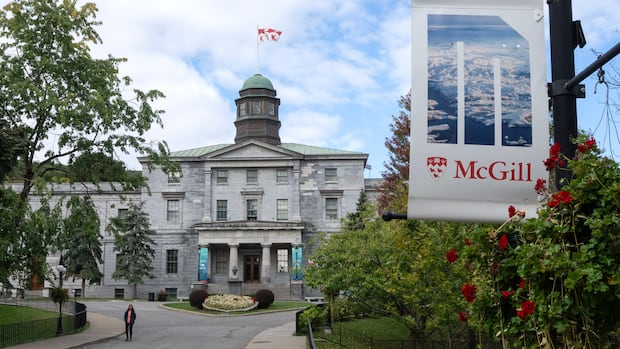
“With this initiative, a Canadian student can study in Barcelona just as effortlessly as at McGill,” Carney remarked during the summit in Montreal.
A specialist in European integration has noted that while the plan is intricate and may incur high costs, it promises substantial advantages for Canadian youth and strengthens connections with the EU.
Erasmus+ provides students in the EU and certain other nations with direct access to funding, institutions, and grants that assist in covering travel and living expenses while engaged in exchange programs between institutions.
Moreover, students are exempt from the tuition, registration, and examination fees that a Canadian exchange student would typically incur when studying in Europe.
However, Erasmus+ is not solely a student opportunity. Its advantages also encompass individuals beginning their careers across various sectors, including trainees, apprentices, youth workers, and academic personnel.
“A welding apprentice from Manitoba could undertake their placement with an employer in Italy, acquiring new skills to bring back home,” Carney explained.
Many Canadian universities have already established partnerships with Erasmus+ through independent arrangements, though these are primarily limited to exchange options for master’s students and faculty members.
Further involvement in Erasmus+ could broaden funding options for undergraduates as well as facilitate youth, training, and sports exchanges—all of which are available to EU member states and the program’s current six associate nations.
How would this work?
Oliver Schmidtke, a professor at the University of Victoria who focuses on European integration, described Canada’s proposed participation in Erasmus+ as “a considerable ambition.”
“Education in Canada is primarily a provincial matter, so how this would be implemented and how the federal government would engage with provincial authorities to manage it—that opens up a multitude of questions,” Schmidtke stated.
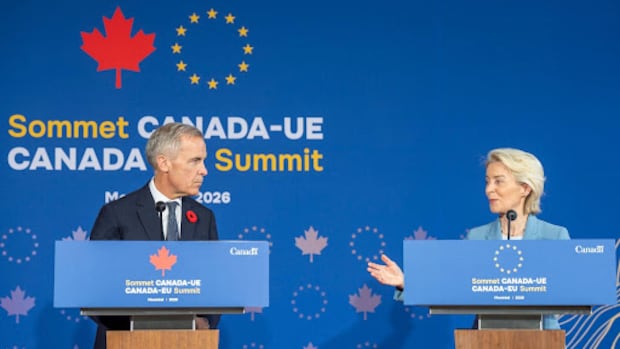
CBC’s David Common speaks with International Trade Minister Maninder Sidhu about Canada’s trading relationship with the EU and beyond. Then we hear from Joost Korte, special envoy for the EU-Canada partnership, from the Canada-EU summit where Prime Minister Mark Carney said Canada is seeking to become the European Union’s first associate member.
Furthermore, joining an international exchange program is not inexpensive. The United Kingdom plans to rejoin in January, incurring over $1 billion in costs for its inaugural year.
Canadian universities would need to “invest substantial amounts to qualify for the full range of services” and offer housing assistance and staff to host Erasmus+ students arriving in Canada, according to Schmidtke.
Additionally, provinces and the European Union would need to establish credit transfer systems for participating students—a challenging task.
All current Erasmus+ members and associated third countries utilize the European Credit Transfer and Accumulation System (ECTS), which streamlines the academic credit transfer process.
When the United Kingdom rejoins, it will implement its own system but has developed a national framework for credit transfers.
In Canada, even credit transfers between institutions within the same province lack consistency.
-
Students across Ontario walk out to protest OSAP changes, tuition hike
-
Ontario estimated to lose more than a 3rd of its international students: StatsCan
This endeavor would occur amidst “significant financial strain on Canadian universities,” Schmidtke noted.
He mentioned that some of this pressure stems from a decline in international students in Canada in recent years—who typically pay higher tuition fees directly to the institutions.
Carney has indicated that the anticipated expenses associated with joining Erasmus+ will not deter Canada from striving toward that objective. Joining was one of the most concrete examples Carney provided when he declared in September that Canada was seeking an “alliance for the future” with the EU.
“We don’t see this as a financial burden,” Carney stated in Montreal regarding the overall costs of closer EU integration. “We perceive this as a coming together.”
Despite these possible challenges, Schmidtke believes that integration with Erasmus+ would present an “invaluable opportunity” for Canadian students.
“Canada is somewhat lagging behind in terms of internationalizing student experiences and mobility,” Schmidtke remarked. “Thus, the Erasmus+ program could serve as a strong impetus to enhance the international experiences of numerous Canadian students.”
Some Canadian universities already involved
The University of Victoria, University of Waterloo, McMaster University, Simon Fraser University, University of Toronto, University of British Columbia, and the University of Calgary have expressed to CBC News their willingness to consider involvement—or further involvement, as some already have ties with Erasmus+—as more information emerges.
Alan Shepard, president of Western University, highlighted that international engagement is a crucial component of the student experience at Western and that the university is eager about the possibilities that Erasmus+ could offer.
“We motivate our students to regard themselves as global citizens by providing opportunities to study, conduct research, and gain practical experience worldwide,” Shepard stated.

In his speech to the European Parliament, Prime Minister Mark Carney said Canadian membership in the EU’s student exchange program, Erasmus+, would give students an opportunity to ‘broaden their horizons’ and build lasting ties to sustain the alliance between Canada and Europe.
At the end of October, Université Laval’s rector Sophie D’Amours and Sorbonne University’s president Nathalie Drach-Temam published an open letter in La Presse urging the government to integrate Canadian universities into the program.
“The Sorbonne is the most ancient French-language university in Europe, while Université Laval is the oldest French-language university in the Americas. Our traditions are robust, as is our ability to assist in addressing future challenges,” the letter stated.
“By collaborating, we will be even more capable of promoting the common good that universities contribute to society.”