
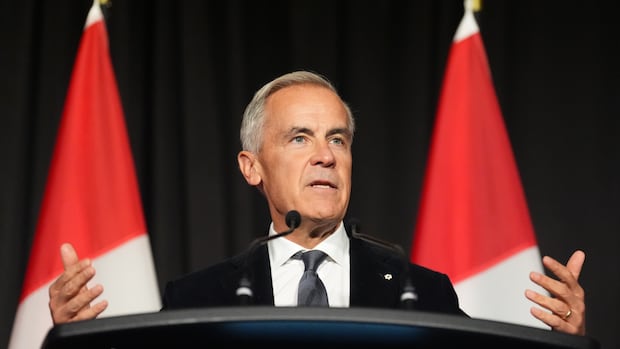


Prime Minister Mark Carney has announced that Canada intends to initiate talks regarding a “distinct alliance” with the European Union, clarifying that this does not involve seeking membership, as he prepares to speak before the European Parliament later this week.
“We are not aiming to join the European Union,” Carney remarked on Sunday evening while attending the Toronto International Film Festival. He participated in the festival shortly after delivering a keynote address to commence the two-day Canada Investment Summit, which kicks off on Monday.
“What we are aiming for — and where we will start discussions — is a distinct alliance with the European Union. Our values align, our priorities are shared, and our strengths complement each other well.”
Carney’s remarks follow a report from the Wall Street Journal on Saturday indicating that he has been advocating for a stronger relationship between Canada and the EU’s 27-member bloc, instructing his team to explore the most ambitious options short of full membership.
The Journal also noted that Carney proposed the idea of Canada adopting the title of “associate member.”
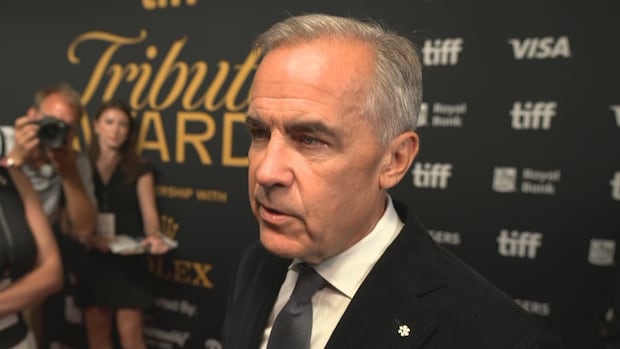
Prime Minister Mark Carney responded to a Wall Street Journal article on the TIFF red carpet regarding the potential for Canada to become an ‘associate member’ of the EU, stating that Canada aims to establish a ‘distinct alliance’ with the bloc, without pursuing membership.
This report triggered a strong backlash from Conservative Leader Pierre Poilievre, who expressed on social media on Sunday evening that Carney is “completely out of touch.”
“We will NEVER be the 51st state of the U.S.,” Poilievre stated. “And we will NEVER be the 28th state of the EU.”
A senior Canadian official, who spoke to CBC on the condition of anonymity, indicated that ongoing discussions have been taking place regarding how Canada can enhance its ties with Europe, aiming for increased sovereignty for the nation.
According to the official, Canada is not seeking to sacrifice its independence for access, emphasizing that the government is more focused on the outcomes of strengthened ties rather than the terminology used.
The official noted that the “associate member” designation is among several options being considered and that Canada did not propose this idea. Furthermore, the government is still exploring what this relationship could entail and aims to outline it more clearly during the EU-Canada summit scheduled for the end of October.
Canada, the EU, and the U.S.
Recently, members of the cabinet have highlighted the importance of Canada strengthening its relationship with Europe as a means to reduce its economic reliance on the United States.
“I believe Canadians can take comfort in knowing that we are pursuing partnerships in a market that is essentially larger than the U.S. consumer market,” Finance Minister François-Philippe Champagne stated in an interview with CBC’s The House on Friday.
Canada continues to be embroiled in a contentious trade dispute with the United States, with Canada implementing $27.6 billion in counter-tariffs earlier this week. The U.S. retaliated by announcing a ban on imports of Canadian alcohol, motorcycles, and various other goods set to take effect on September 29.
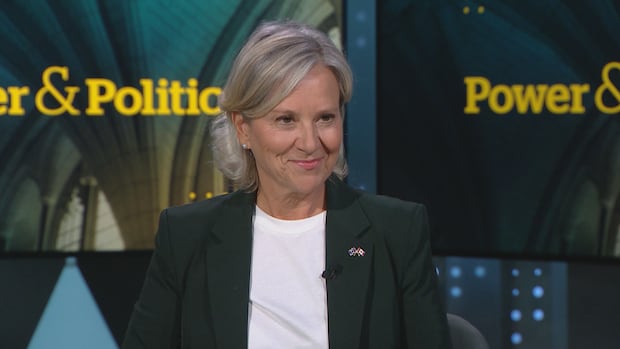
Power & Politics discusses with EU Ambassador to Canada Geneviève Tuts as Prime Minister Mark Carney prepares to address the EU Parliament next week. Tuts emphasizes the importance of enhancing Canada-EU relations in light of recent actions by U.S. President Donald Trump.
In a recent interview with Power & Politics, EU Ambassador to Canada Geneviève Tuts noted that while the two entities already collaborate effectively, both sides are eager to “advance beyond the current state.”
“We are seeking not only a new partnership but something significantly different and uniquely beneficial,” Tuts expressed. “We aim to reimagine the relationship between Canada and the EU.”
Carney is set to visit Strasbourg, France, on Tuesday and will address the European Parliament on Thursday, following an invitation from President Roberta Metsola.
Canada is also slated to host an EU summit on October 29 and 30.