
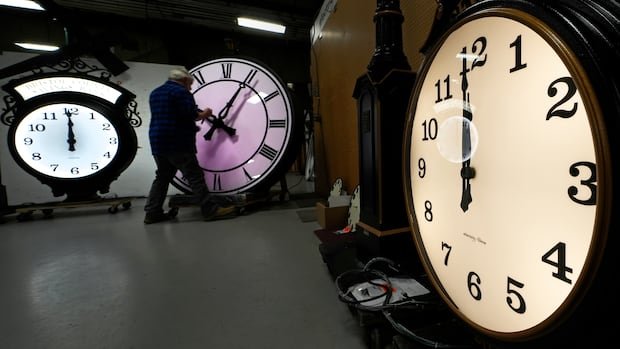


In a significant move, an international timekeeping body based in France has made a decision to eliminate “leap seconds” after over five decades of usage. This decision entails allowing the clocks to gradually drift out of synchronization by a full hour, a process that could span centuries or even millennia.
The precise atomic time, established in the 1950s by tracking atomic vibrations, deviates slightly from solar time, which references the sun’s position relative to a specific Earth location due to the planet’s slowing rotation. To rectify this discrepancy, the leap second was introduced in 1972, initially adding ten seconds. The International Earth Rotation and Reference Systems Service has since monitored this variance, determining when an additional second is required. Leap seconds have been inserted 27 times, with the most recent occurrence in 2016.
If these minute adjustments were not implemented, noticeable changes would not occur in our lifetimes. However, without them, a scenario could arise where the brightest part of the day coincides with midnight and the darkest part with noon. This concept mirrors leap years, where a day is added to February every four years to align the Gregorian calendar with seasons, as Earth’s orbit around the sun takes approximately 365¼ days.
The decision to phase out leap seconds stems from the increasing challenges they pose to systems reliant on precise timekeeping. The method of implementing leap seconds varies among entities, potentially leading to system failures. Past instances, such as Reddit and LinkedIn crashes in 2012 and Cloudflare outages in 2016, have been attributed to leap seconds.
Moreover, a recent acceleration in Earth’s rotation speed has raised the prospect of a “negative leap second” in the future. This change, approved by the International Bureau of Weights and Measures, involves accumulating extra seconds until reaching 3,600, equivalent to an hour, before adjusting the clocks, a change set to take effect in May 2027.
While some experts view this approach unfavorably, citing potential challenges for technology-driven economies, others suggest that there is no perfect system to account for Earth’s shifts. Samantha Lawler, an astronomy professor, emphasizes that imperfections in timekeeping have been a longstanding human dilemma and that a degree of inaccuracy is inevitable due to the complexities involved.