
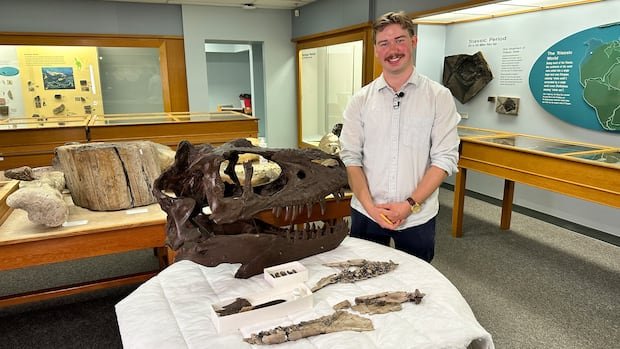


Researchers from the University of Alberta have uncovered a startling revelation suggesting that a raptor dinosaur might have preyed upon a much larger tyrannosaur in ancient times. The discovery was made through the observation of bite marks on the jawbone of an Albertosaurus, a relative of the renowned Tyrannosaurus rex that inhabited Alberta approximately 70 million years ago. The fossil in question belonged to an eight-year-old Albertosaurus that had not yet reached full maturity, prompting researchers to consider two divergent theories regarding the events following the dinosaur’s demise near Drumheller, Alberta.
According to the researchers, the most plausible scenario indicates that a raptor, a smaller carnivorous dinosaur, fed on the larger Albertosaurus post-mortem, following its death from unknown causes. This rare occurrence of one carnivorous dinosaur consuming another provides valuable insights into the interactions among predatory dinosaurs and the intricate dynamics of the prehistoric food chain. The findings, led by Joshua Doyon, a paleontology master’s student at the University of Alberta, involved analyzing the spacing between the bite marks and comparing them with the teeth of contemporary carnivorous dinosaurs, ultimately pointing to a raptor as the likely culprit.
Alternatively, it was proposed that the Albertosaurus could have been cannibalized by a much younger member of its own species, measuring less than two years old and about two meters in length. The discovery of the fossil in 2022, by a member of the public exploring the badlands north of Drumheller, led to its collection by the Royal Tyrrell Museum. Subsequent examination of the fossil during preparation unveiled the tooth marks, sparking Doyon’s research project in 2023.
Doyon, intrigued by studying dinosaur behavior and interspecies interactions, seized the opportunity presented by the specimen to delve into a feeding interaction from millions of years ago. The significance of this finding lies in its contribution to understanding dinosaur biology by scrutinizing fossil details beyond mere identification and description. Insights gleaned from features like tooth marks can shed light on predator-prey relationships and species dynamics within ancient ecosystems. The Albertosaurus, as an apex predator, coexisted with a comparatively smaller raptor species, underscoring the rarity of evidence depicting one carnivorous dinosaur feeding on another, rather than on herbivorous prey.
Contrary to popular depictions in the film “Jurassic Park,” the raptors found in Alberta, specifically the dromaeosaur Atrociraptor, were notably smaller than their cinematic counterparts. Doyon emphasized the importance of paleontologists and the public alike paying attention to subtle tooth marks on discovered dinosaur bones, as they may hold crucial clues that might otherwise be overlooked.