
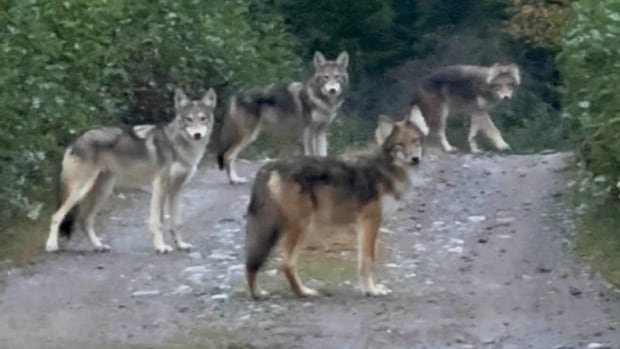


Provincial wildlife authorities are pleased with the reports of uncommon canids such as coyotes and wolves, as they are actively monitoring and seeking to enhance their understanding of these animals’ presence on the island and in Labrador.
The recent spotlight on the possibility of wolves on the island was sparked by Nikita Compton, who encountered and shared images online of a small group of animals near Goose Arm, situated between Deer Lake and Corner Brook, leading to speculation about their identity.
While it remains challenging to definitively identify these animals without testing, wildlife officials are eager to gain more insights into the broader canid population.
The Department of Forestry, Agriculture and Lands of the Government of Newfoundland and Labrador, which oversees the Wildlife Division, revealed in a recent email that a distinct Newfoundland wolf subspecies, believed to be different from the Labrador wolf, became extinct in the 1930s. However, Labrador gray wolves have been more recently documented on the island, with records dating back to 2008 and 2012.
Since 2013, the Wildlife Division has been studying the movement of these animals. Genetic results from approximately 500 canid carcasses collected in the province have been analyzed by biologists, revealing that five animals had a mix of coyote and domestic dog ancestry, while four were confirmed as Labrador wolves. Wolf DNA traces were found in 28 samples.
The province states that the wolf population on the island is low, with genetic evidence indicating interbreeding between wolves and coyotes. Despite the presence of wolf genetics, the larger coyote population is likely to dilute the wolf genetics within the island’s canid population.
The difficulty in determining the genetic background of a coyote solely based on its appearance is acknowledged by department staff, emphasizing that coyotes exhibit natural variations in size, coloring, and body proportions. They also stress that an unusual-looking coyote may not necessarily be a recent wolf or dog hybrid.
Although the canid mystery has piqued interest, the ongoing research into the province’s wildlife is expected to benefit from the public’s involvement. Hunters and trappers are encouraged to submit coyote and wolf carcasses, providing valuable information on the impact of coyote colonization on the island and the potential pathways for wolves to travel from Labrador to the island.
Efforts are underway to increase the number of canid samples from Labrador to improve the detection of animals with wolf genetic ancestry. It is not limited to the island, as hunters and trappers in Labrador are urged to report canid carcasses to the Wildlife Division.
For public safety, provincial wildlife authorities remind that coyotes and wolves are seldom aggressive towards humans. However, it is advised not to initiate contact with these animals or feed them. If encountering a coyote or wolf, individuals are advised to remain calm, avoid running, and make noise to deter the animal, such as yelling or clapping. Making oneself appear larger by waving arms is also suggested. If the animal persists, one should continue to make noise while slowly retreating.
Stay updated on CBC Newfoundland and Labrador news by downloading the free CBC News app for push alerts. Visit the CBC Newfoundland and Labrador landing page for more information.