
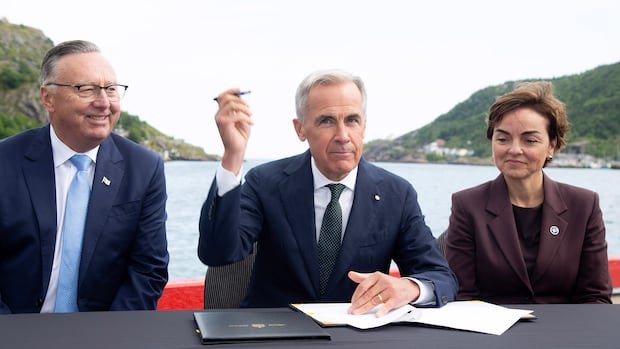


Newfoundland and Labrador Premier Tony Wakeham has decided not to proceed with a public referendum on a new Churchill Falls deal, citing changing political circumstances. Wakeham, who had promised a referendum during the provincial election campaign, revealed a new deal alongside Prime Minister Mark Carney and Quebec Premier Christine Fréchette. Despite the initial promise of a referendum, Wakeham acknowledged the disappointment this decision might bring to the public.
In an interview with CBC Radio’s The St. John’s Morning Show, Wakeham explained that the involvement of the federal government had presented a significant opportunity that was not previously considered. He noted that recent changes, including the impact of the U.S. trade war, had influenced the decision-making process.
The upcoming special debate in the House of Assembly on September 14 will provide Members of the House with the opportunity to review the details of the new deal. Wakeham emphasized that the revised agreement, which supersedes a previous MOU from 2024, offers better terms for the province. He highlighted key benefits, such as the ability for Newfoundland and Labrador to sell power to Quebec or utilize excess power to support local industries.
Furthermore, the agreement includes provisions for loan guarantees for the Gull Island hydroelectric project, investment tax credits, and assistance from Ottawa in constructing the Labrador Transmission Line. Wakeham expressed optimism about finalizing the agreement by the end of the year, despite uncertainties related to the upcoming Quebec election.
Energy N.L. CEO Charlene Johnson expressed enthusiasm for the opportunities presented by the energy projects, emphasizing the potential for economic growth and job creation in the region. She underscored the importance of Newfoundland and Labrador’s natural resources in meeting global energy demands, particularly in the current geopolitical climate.
The partnership between federal and provincial governments, along with private sector involvement, is seen as a crucial step towards achieving sustainable energy goals and driving economic development in the region.
[End of rewritten article]