
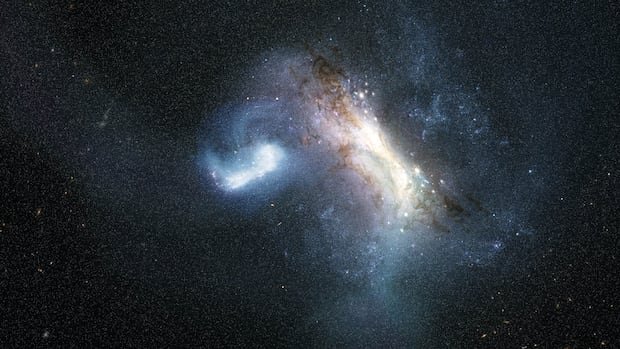


A recent study has shed light on the early history of the Milky Way galaxy, revealing a significant event that occurred about 11.8 billion years ago. Researchers have found evidence that the Milky Way absorbed a smaller galaxy, known as a dwarf galaxy, during its infancy. This galactic merger marked a crucial moment in the Milky Way’s development, demonstrating how the galaxy grew not only by creating its own stars but also by merging with smaller galaxies that were drawn into its gravitational pull.
Using data from the Hubble and Gaia telescopes, scientists studied clusters of stars near the center of the Milky Way, analyzing their age, chemical composition, and trajectory. The research indicates that the dwarf galaxy involved in the merger, named Low-energy-Kraken-Heracles (LKH), contained stars with a mass equivalent to 500 million times that of the sun at the time of the merger.
The merger injected a significant amount of stars and interstellar gas into the Milky Way, fueling star formation and contributing to the galaxy’s growth. This infusion of material, including dark matter, from the dwarf galaxy played a crucial role in shaping the Milky Way’s early evolution.
According to lead author Davide Massari, the merger was relatively peaceful in terms of star interactions, but it triggered an explosive collision of gases, leading to the formation of numerous stars. The study’s findings provide valuable insights into the Milky Way’s past and its ongoing interactions with other galaxies, such as the Gaia-Sausage-Enceladus merger and the ongoing merger with the Sagittarius dwarf galaxy.
By unraveling the Milky Way’s history through such mergers, researchers aim to answer fundamental questions about the origins of our solar system and Earth. The study underscores the complex and dynamic nature of galaxy evolution and its profound impact on the cosmos.
[Source](https://www.cbc.ca/news/science/milky-way-9.7310896)