
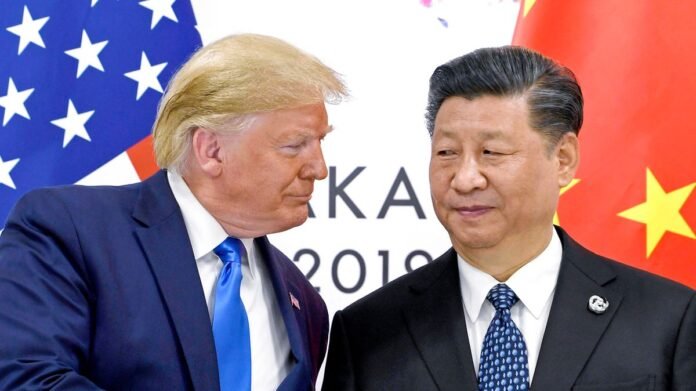


In a recent development, an expert has cautioned that a significant military restructuring in China has caught Donald Trump off guard, potentially signaling preparedness for conflict. Chinese President Xi Jinping recently dismissed senior generals He Weidong and Miao Hua as part of a broader overhaul aimed at readying the nation’s military for combat, amidst allegations of serious corruption involving top military officials.
Following these dismissals, new images have surfaced revealing extensive construction activities at a secretive military facility in northwest China, hinting at the establishment of a potential underground nuclear testing site. This move by China coincides with ongoing changes within the US military under President Trump and Defense Secretary Pete Hegseth, who have been implementing reforms targeting what they refer to as “woke generals.”
Comparing the strategic nature of China’s military revamp to the political undertones in the US military shake-up, security expert Professor Anthony Glees highlighted the contrasting approaches. Glees emphasized the risk of the US lagging behind as China strengthens its military capabilities, cautioning that the recent developments, including the construction of a new testing base, should be a cause for serious concern.
Xi’s actions in purging top military officials like He Weidong demonstrate a clear agenda to align the Chinese military with the Communist Party’s interests, mirroring Hegseth’s efforts to ensure loyalty within the US military to President Trump. Unlike the democratic checks in the US, Xi’s authoritarian control allows for swift and decisive military restructuring without public scrutiny, enabling China to potentially enhance its nuclear arsenal to match those of the US and Russia.
While China currently possesses fewer nuclear warheads compared to the US and Russia, its rapid stockpile growth rate since 2023 indicates ambitions to close this gap. Additionally, the recent unveiling of China’s newest aircraft carrier, the Fujian, equipped with advanced launch technology, underscores China’s expanding naval capabilities, posing challenges to US naval supremacy and strategic interests.
China’s advancements in naval technology, including the adoption of cutting-edge systems like the Electromagnetic Aircraft Launch System (EMALS), put pressure on the US and its allies to maintain military parity in the region. The escalating military developments in China highlight a shift in global power dynamics, with implications for regional security and strategic balance.